
Guides & Advice
What Is Aniline Leather? Aniline vs Semi-Aniline vs Pigmented
Oct
What is aniline leather? It is leather dyed all the way through with soluble dyes and left without a covering layer of pigment on the surface. You see the hide as it really is: its pores, fine wrinkles and natural shade variations. It is the softest leather to the touch and the one that develops a patina fastest, but also the most sensitive to stains and water. Next to it, semi-aniline leather gets a thin protective coat, and pigmented leather a real opaque layer of colour. Knowing these three finishes helps you choose a men’s leather shoulder bag for the life you will give it, rather than from a product photo alone.
What aniline leather actually is
The name comes from aniline, a compound used to make the first synthetic dyes in the nineteenth century. Today the word describes a way of finishing leather rather than one specific dye. The tanned hide goes into a dye bath that colours it right through, then receives at most a very light, transparent finish. Nothing hides its surface.
That transparency has a direct consequence: only the best hides can be finished as aniline. A scar, an insect bite or a deep wrinkle stays visible. Aniline leather is therefore almost always a top quality grain leather, often full grain leather, which explains its price. Tanneries keep the cleanest hides, sometimes only a small share of a batch, for aniline work, and send the rest to semi-aniline or pigmented finishing.
Aniline vs semi-aniline vs pigmented leather
The three finishes differ by how much material sits on the hide after dyeing. The table sums up what each one changes for a bag or a wallet.
| Feature | Aniline | Semi-aniline | Pigmented |
|---|---|---|---|
| Surface finish | none or almost none | thin, lightly pigmented coat | opaque pigment layer |
| Look | visible pores, natural shade variation | visible grain, more even colour | uniform colour, grain sometimes embossed |
| Feel | very soft and warm | soft | firmer |
| Stain resistance | low | medium | high |
| Patina | strong and fast | moderate | almost none |
| Best for | pieces you want to age | daily bags that should still feel natural | bags exposed to spills and rain |
Semi-aniline is the compromise most bag makers settle on: it keeps much of the hand feel and grain of aniline, but a light coat evens out the colour and buys time when coffee or rain hits the surface. Pigmented leather is the workhorse. Its colour layer hides small defects in the hide, which is why it is used on lower grades too, and why it looks the same on day one and after five years. Our guide to the types of leather places these finishes next to the leather grades.
Pull-up leather: an oiled aniline that changes colour
Pull-up leather is an aniline or semi-aniline leather loaded with oils and waxes. When you fold it or pull it, the wax moves and the colour lightens at that spot, hence the name. The best known is crazy horse, a waxed full grain cowhide whose fresh scratches often fade with a simple rub of the thumb. Our page on crazy horse leather explains this behaviour, and our guide to leather patina shows why these leathers darken and improve over the years.
How to tell if leather is aniline
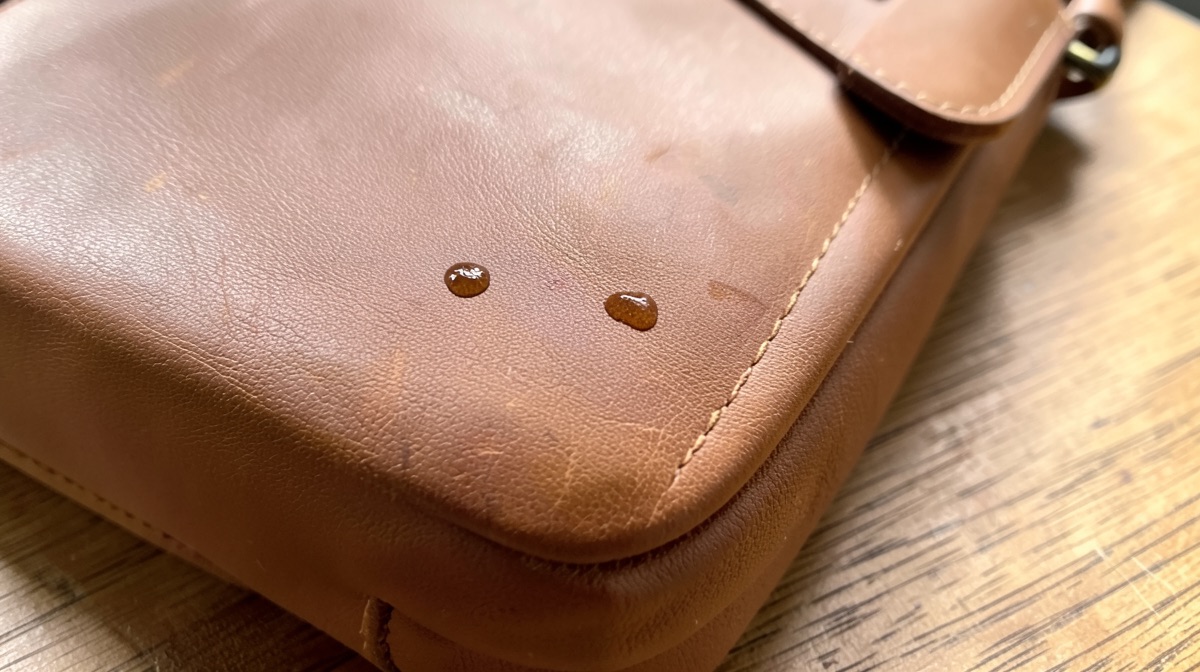
- The water drop test. On a hidden spot, a drop of water soaks in within seconds and darkens aniline leather, then fades as it dries. On pigmented leather it beads on the surface.
- The pores. Under raking light you can see pores and small irregularities. A grain that looks too perfect and repetitive usually means corrected, pigmented leather.
- The feel. Aniline is supple and slightly warm in the hand. It marks under a fingernail, and on pull-up leather the mark turns lighter.
- Shade variations. From one panel of a bag to the next, the colour can vary slightly: that is the signature of a dye with no covering layer.
- The label and the price. Makers who use aniline say so, because it costs more. A low priced bag described only as “genuine leather” is rarely aniline.
If you are unsure, our method to tell real leather from imitation is the first check to run, before looking at the finish.
How to care for aniline leather
Leather without a protective layer asks for a little attention, not a chore. Dust it with a soft dry cloth, feed it with a suitable colourless conditioner once or twice a year, and keep it away from radiators and direct sun, which fade it. Deal with an oil stain quickly, before it spreads into the fibre: our guide on how to remove stains from leather gives the steps. Before a rainy season, a breathable protector limits water marks, as explained in our article asking is leather waterproof. Avoid alcohol, household soap and cleaning wipes, which dry out and bleach unprotected leather. If a water mark appears anyway, dampen the whole panel evenly with a barely wet cloth and let it dry naturally: the mark blends into the rest instead of leaving a ring.
Our waxed and patina leather bags
To feel the difference between a leather that lives and a pigmented one, here are a few crazy horse pieces from our catalogue:
- a messenger bag of about 35 x 25 x 8 cm for the daily commute, in dark brown or aged brown. See the crazy horse messenger bag;
- a large flap shoulder bag whose corners lighten within the first weeks. See the crazy horse flap bag;
- a short bifold wallet in waxed crazy horse. See the crazy horse wallet;
- the whole family in our leather messenger bag for men range.
In short
Aniline leather is dyed right through and left almost bare: the most beautiful and the softest, but the most sensitive. Semi-aniline adds a light protection, pigmented leather puts consistency and resistance first. Choose aniline for a piece you want to see age, pigmented for a bag that will meet spills and rain. Compare all our leathers in the men’s leather shoulder bag range.
Frequently asked questions
Is aniline leather durable?
The hide itself is as strong as any full grain leather, since it is often the same hide. What is more delicate is the surface: with no protective layer, it marks more easily with water, grease and scratches.
What is the difference between aniline and semi-aniline leather?
Semi-aniline leather receives a thin, lightly pigmented coat after dyeing. It keeps much of the feel and grain of aniline, with a more even colour and better stain resistance.
Does aniline leather develop a patina?
Yes, faster than any other finish. Light, friction and the oils from your hands darken and soften it over time.
Is aniline leather good for a bag?
For a bag you carry with care and want to see age, it is the most rewarding choice. For a bag that lives on café floors and in the rain, semi-aniline or pigmented leather will stay presentable with less effort.
