
Guides & Advice
Types of Leather: Layers, Finishes and Tanning Explained
Sep
The types of leather differ by the layer of hide used, the tanning and the finish. Those three choices, far more than the word leather on a label, decide how a bag holds up over the years. This guide ranks the leathers you meet in bags and small leather goods, from the toughest to the most delicate, with what each is really worth on a leather shoulder bag for men.
Contents
This guide sorts leathers by layer, finish and tanning, and links through to our leather messenger bags.
- Types of leather by layer of hide
- Leather types defined by their finish
- Tanning, the part you cannot see
- Fake and reconstituted leathers
- What each type of leather costs
- Ethics, chrome and vegetable tanning
- Hides beyond cattle
- Label wording and what it is worth
- Real lifespan, by type
- Identifying leather in a shop, in five checks
- Which leather for which use
- Thickness, weight and structure
- What our catalogue shows
- Our leather selection
- Conclusion
- Frequently asked questions
Types of leather by layer of hide
A thick hide is split into layers. The top layer, the grain, carries the natural surface and the tightest fibres: it is the strongest. Full grain leather keeps it intact, pores and marks included. Top grain, or corrected grain, is sanded and coated with a pigmented film to hide flaws. Split leather comes from the lower layer: less dense, it often becomes suede or gets a film that imitates grain.
| Type | Layer | Strength | How it ages |
|---|---|---|---|
| Full grain | Intact grain | Very high | Develops a patina |
| Top grain | Sanded grain | High | Stays uniform |
| Split leather | Lower layer | Medium | Can mark |
| Bonded leather | Glued fibres | Low | Flakes apart |
| PU leather | None, synthetic | Varies | Peels in time |
Leather types defined by their finish
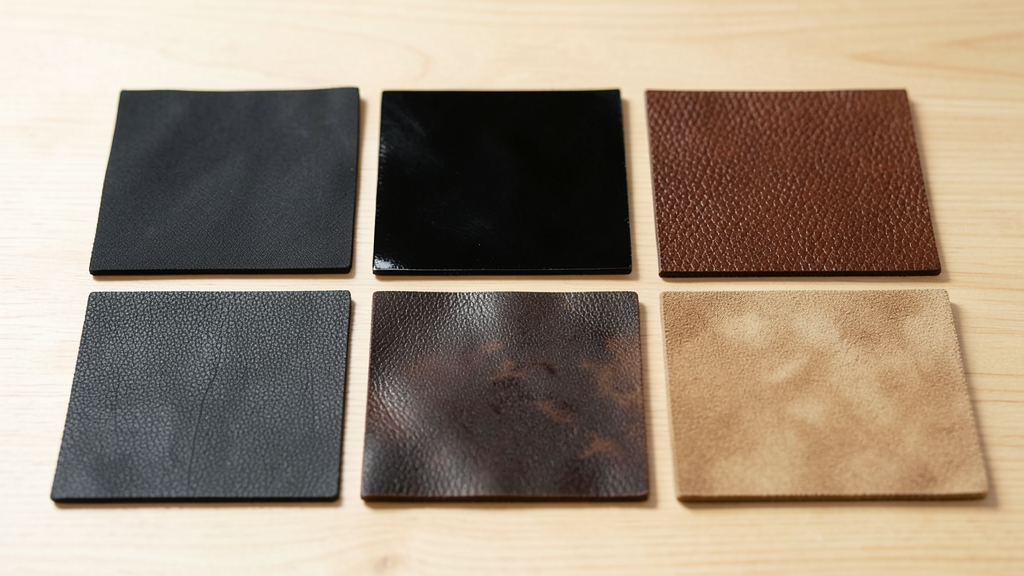
The same hide changes name with its surface treatment. Nappa leather is a very soft grain leather dyed through. Patent leather gets a glossy coating that makes it almost waterproof. Pebbled leather carries an embossed texture that hides scratches. Crazy Horse leather is oiled and waxed and lightens at every fold. Nubuck and suede are buffed for a velvet feel.
- Nappa: soft and supple, dislikes repeated rubbing.
- Patent: glossy and water resistant, cracks at folds.
- Pebbled: tough, hides everyday marks.
- Crazy Horse: fast patina, scratches fade when rubbed.
- Nubuck and suede: velvet touch, sensitive to water and grease.
Tanning, the part you cannot see
Chrome tanning is fast and cheap, and gives supple leather with bright colours that change little. Vegetable tanned leather spends weeks in bark tannins: firmer at first, it darkens and builds a patina with light and handling. Neither is better in absolute terms. Chrome suits bright colours and soft bags, vegetable tanning suits objects you keep for years.
Fake and reconstituted leathers
Two families often pass for leather. Bonded leather glues ground scraps together: it contains leather, but it flakes at the folds within a few years. PU leather is fully synthetic, a polyurethane film on a fabric backing, light and even, and it does not pretend to age like leather.
What each type of leather costs
Leather prices follow two variables: how much of the hide is usable, and how many tanning steps it takes. Vegetable tanned full grain needs weeks in pits or drums and rejects any hide with a visible scar, so its cost per square decimetre runs three to five times that of coated split. Corrected grain, by contrast, rescues imperfect hides through sanding and embossing, which explains both its low price and its dominance in mass retail.
Our leather messenger bags sit in the middle of that range. For a buyer the consequence is simple: on a bag under fifty euros advertised as leather, the material is almost always coated split or bonded. That does not disqualify it, as long as you know it and expect two or three years of service rather than a piece that patinas.
Ethics, chrome and vegetable tanning
Two questions come up constantly. The first is chrome: around 85 percent of the world’s leather is chrome tanned, a fast process that gives supple, colorfast hides. Chrome III used in tanning is not the toxic chrome VI that makes headlines, but tannery effluent needs proper treatment, which is exactly what certification schemes audit. The second is the animal: leather is a by product of the meat industry, not its purpose, and hides that are not tanned are destroyed.
Vegetable tanning uses plant tannins, takes weeks instead of hours, and produces the hides that age best. It is not automatically cleaner, since it consumes more water and time, but it avoids metal salts entirely. If the question matters to you, look for a tannery name and a certification rather than a marketing word, and read our article on vegetable tanned leather.
Hides beyond cattle
Most leather goods use cowhide, but other skins have specific uses. Calf gives a fine, tight grain, favoured for structured pieces and wallets. Lamb is thin and supple, kept for jackets, gloves and linings. Goat, often sold as kid, has a marked grain and surprising strength for its thickness; you find it on soft bags and bookbinding.
Buffalo is thicker and more grained than cattle hide, with a rugged look that ages well on a travel bag. Pigskin, recognisable by its three grouped pores, is mostly a lining. Exotic skins, crocodile, ostrich, python, come under strict regulation and prices unrelated to daily use. Our shelves are essentially cowhide, as our article on full grain leather explains.
Label wording and what it is worth
- Genuine leather: says nothing about which layer was used. It covers full grain and heavily pigmented corrected hide alike.
- Full grain: the grain is intact, not sanded. The most demanding claim, and the rarest.
- Corrected grain: the surface was sanded to remove flaws, then re embossed. The grain you see is printed.
- Split leather: the lower layer, with no grain, usually coated. Far weaker in tearing.
- Bonded leather: ground fibers glued together and sold as leather. Avoid on anything that flexes.
To settle it, go back to the five checks above and to our article on bonded leather.
Real lifespan, by type
Well kept full grain passes ten years on a bag carried daily, and far more on a belt or a wallet. Corrected grain lasts five to eight years, the finish eventually flaking at the corners. Coated split rarely passes three years in daily use: the coating crazes and the fibrous layer shows through. Bonded leather falls apart in one to three years.
These figures assume the care set out in our guide on how to condition leather, meaning regular dusting and conditioning twice a year. Without it, halve every number, and the gap between types narrows: dry leather cracks, whatever its original quality.
Identifying leather in a shop, in five checks
- Look at the cut edge: full grain shows dense fibers at the top and looser ones below, with no plastic layer. A bright, perfectly even line means a coating or bonded leather.
- Press with your thumb: natural leather wrinkles into fine lines that close again; corrected or coated leather takes a sharp crease that stays.
- Put a drop of water on it: it darkens bare leather within seconds, beads on pigmented leather, and sits untouched on a coating.
- Smell it: vegetable tanned hide smells woody, pigmented cowhide smells of little, PU smells of plastic or glue.
- Look for irregularity: insect bites, growth lines, healed scars. A perfectly even grain across a whole panel is almost always embossed.
These five checks take a minute and sort nine articles out of ten. They do not replace the label, but the label stays vague: “genuine leather” covers full grain and heavily corrected hide alike, as our article on bonded leather explains.
Which leather for which use
| Use | Best leather | Why |
|---|---|---|
| Daily work bag | pigmented cowhide or oiled leather | takes friction, wipes clean |
| Bag meant to age and patina | vegetable tanned full grain | darkens and smooths with use |
| Wallet | thin full grain or calfskin | low bulk, holds up over years |
| Sports or rain bag | canvas, nylon or coated leather | water leaves no mark |
| Dressy, evening piece | patent or nappa | shine or softness, low wear resistance |
The choice follows the use, not the name. Patent leather that looks superb at an event scratches on the first commute, and full grain meant to patina disappoints anyone who wants a bag that never changes.
Thickness, weight and structure
Leather is measured in tenths of a millimetre, or in ounces in the English speaking trade. From 0.8 to 1.2 mm suits a wallet or a lining. From 1.2 to 1.8 mm you are in soft bag territory. Above 2 mm the hide stands on its own and serves structured satchels, belts and bag bases.
Thicker is not automatically better: it adds weight and needs breaking in. A thin, well tanned hide outlasts a thick one of poor origin. What matters is fiber density, which you feel with your fingers: a dense hide springs back after pressure, a spongy one keeps the mark. That single test separates a leather messenger bag that lasts ten years from one that sags within a season.
What our catalogue shows
Out of the 1,109 products in our shop, 397 mention leather. 86 are listed as genuine leather, 84 as PU leather, 38 as cowhide, 33 as full grain and 10 as Crazy Horse. None is nappa or patent leather: both finishes handle rubbing against a hip and the knocks of a daily bag poorly. To tell full grain from top grain, look at the edge, the smell and the pores, never the label alone.
One last check before you buy
Ask which layer of the hide was used and how it was tanned. A seller who can answer both questions is describing a real material; one who only repeats “genuine leather” is describing a label. That single exchange tells you more than any price tag, and it applies just as well to our own leather briefcases.
Our leather selection
- Leather shoulder bags for men, from tablet size to laptop bags.
- Leather messenger bags, with flaps, for office and city.
- Mens leather wallets, in cowhide and Crazy Horse.
See all leather shoulder bags for men
Conclusion
For a bag carried every day, aim for full grain or a pebbled or oiled finish, which take the wear and improve with it. Keep nappa and patent for objects you treat gently, and take PU leather for what it is: light and affordable, not everlasting. Browse our leather shoulder bags for men and our guide on how to condition leather.
Not every type takes color the same way: our guide on how to dye leather explains which finishes absorb dye and which need leather paint.
Frequently asked questions
What is the strongest type of leather?
Full grain leather, because it keeps the densest fibre layer of the hide. It resists wear and tearing better than any other layer.
Is genuine leather the best quality?
No. Genuine leather only guarantees that it is leather, not which layer. It often means corrected grain or split leather.
What is the difference between cowhide and full grain leather?
Cowhide names the animal, full grain names the layer. A leather can be both, or be split cowhide.
Is PU leather real leather?
No, it is a synthetic polyurethane material. It copies the look of leather without its fibrous structure.
