
Guides & Advice
How to Tell Real Leather from Synthetic in Ten Seconds
Sep
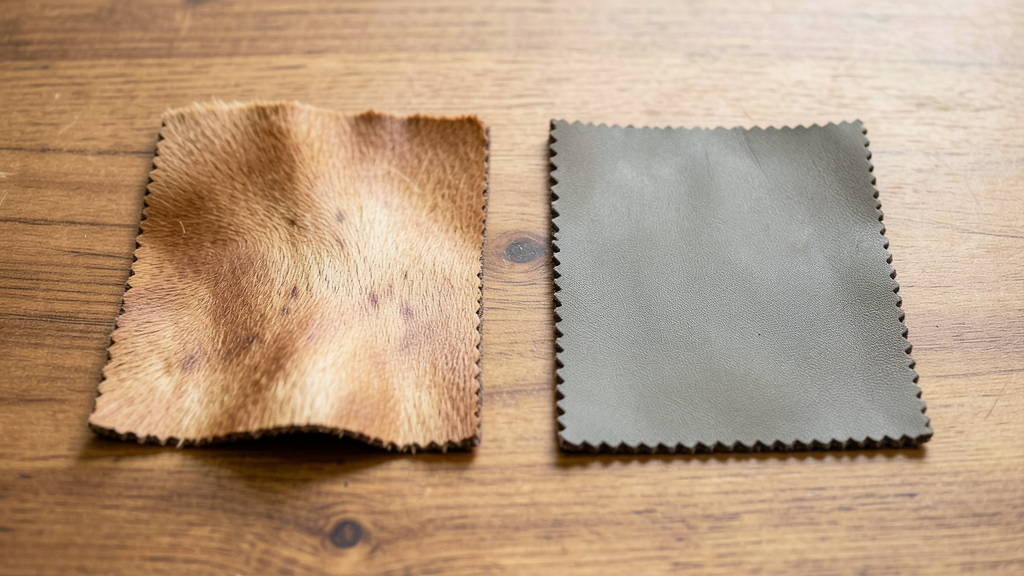
How to tell real leather from synthetic takes three checks and about ten seconds: the cut edge, the grain pattern, and a drop of water. Smell and the flame test, the two most quoted online, are the least reliable. The method works on a jacket, a sofa or a leather messenger bag alike.
The three checks that settle it
- The cut edge: real hide shows a fibrous, irregular thickness. Synthetic shows a clean woven backing, sometimes a thin foam line.
- The grain: on an animal hide the pattern never repeats. On a coated fabric, it repeats at a fixed interval, because it was embossed by a roller.
- Water: a drop on unfinished leather darkens and sinks within a minute. On synthetic, it beads indefinitely.
Do these on a discreet area, inside a flap or under a tab. On a new item in a shop, the cut edge is usually the only one available without damage: look for an open seam or a trimmed border inside a pocket. Our guide to suede vs nubuck covers the napped finishes, where these checks differ.
Why smell and flame tests mislead
One more myth deserves retiring: the idea that real leather always has visible pores. Heavily pigmented hides are sprayed and embossed, which hides the pores almost completely, while some synthetics are embossed WITH pores to imitate them. Pores tell you about the finish, not about the material, a point our guide on what is nubuck develops for sanded hides.
Synthetic hides are routinely scented at the factory to evoke leather, and a genuine pigmented hide can smell of nothing at all. Smell therefore separates nothing reliably. The flame test destroys the item, and it tells you only what the cut edge already showed, which makes it the worst trade in the list.
The label is no better on its own. Terms like genuine leather, bonded leather and leather look sit on a spectrum from real hide to ground fibre glued onto fabric. Only the cut edge tells you where a given piece actually falls.
Full grain, top grain, split: all real, not all equal
| Grade | What it is | How it ages |
|---|---|---|
| Full grain | top layer, natural surface untouched | patinas, marks, repairs well |
| Top grain | top layer lightly sanded and coated | even colour, limited patina |
| Split | lower layer with an applied finish | keeps its look, does not patina |
| Bonded | ground fibre glued to a backing | peels at the edges over time |
All four are sold as leather, and only the first two justify the price most buyers imagine. The difference shows on the cut edge again: a uniform colour through the thickness signals a coated split or a bonded sheet, as explained in our page on leather patina.
What synthetic does better
It ignores rain, wipes clean with a damp cloth and needs no conditioning. It keeps its colour: no patina, so no darker zones where hands rest. On a bag carried daily on public transport, that stability is a genuine advantage rather than a compromise.
It also costs far less per surface, which allows formats and colours that leather would make unreasonable. Of the 1,167 bags published on our site, 348 are leather and a meaningful share of the rest is coated fabric, for exactly that reason, and they need none of the care described in how to remove stains from leather.
What real leather does better
There is also a comfort difference people notice before they can name it: hide adapts to temperature and to the body, softening where it is handled. A coated fabric stays exactly as rigid in January as in July. On a strap worn against the shoulder for hours, that difference is felt long before it is seen.
Hide can be repaired, fed and recoloured: a scratch fades, a shade is restored, a seam is redone. Synthetic wears at the surface, and once the coating goes, nothing replaces it. That is the real divide, between a material that ages and one that degrades.
Lifespan depends mostly on how the piece is used rather than on the grade alone. A full grain bag left folded in a hot car cracks at the fold like any coated fabric would, which is why our guide on how to condition leather starts with storage rather than with products.
Bags where the material is stated plainly
- Leather messenger bags: full grain and top grain hides.
- Leather briefcases: structured hides with a covering flap.
- Leather wallets: small panels where the grade is easy to inspect.
Conclusion
Check the cut edge, check whether the grain repeats, then put a drop of water on a hidden spot. Those three answer the question faster and more reliably than smell or fire. Then decide what you actually want: a hide that ages and repairs, or a coated fabric that stays exactly as it is. Start with our leather messenger bags.
FAQ
Does genuine leather on a label mean good leather?
No. It only means some hide is present. Bonded leather carries ground fibre glued to fabric and still uses the word.
Is the smell test useless?
Largely. Synthetic hides are scented at the factory, and pigmented hides can smell of nothing. Use the cut edge instead.
Can water damage real leather during the test?
One drop on a hidden spot darkens briefly and fades as it dries. On pale unfinished hide, keep it to a single drop in a concealed area.
How do I tell full grain from top grain?
Full grain shows pores and small natural marks; top grain looks evener because the surface was sanded and coated.
Is synthetic always worse?
No. It resists rain, keeps its colour and needs no care. It simply cannot be repaired once the coating wears through.
