
Guides & Advice
What is pull-up leather? Oiled leather, care and our bags
Nov
Short definition: pull-up leather is leather whose fibres were filled with oils and waxes during tanning, so the colour shifts and lightens where you bend, pull or rub it, then settles back. It is also sold as oiled leather or waxed leather. This page explains what the terms mean, how the leather is made, how to recognise it and how to look after it, then reads seven pieces from our men’s leather shoulder bags with the material and sizes each product page states.
- Definition
- Pull-up, oiled, waxed
- How it is made
- How to recognise it
- Pull-up, crazy horse, nubuck
- Seven pieces read
- Care
- Questions
What is pull-up leather?
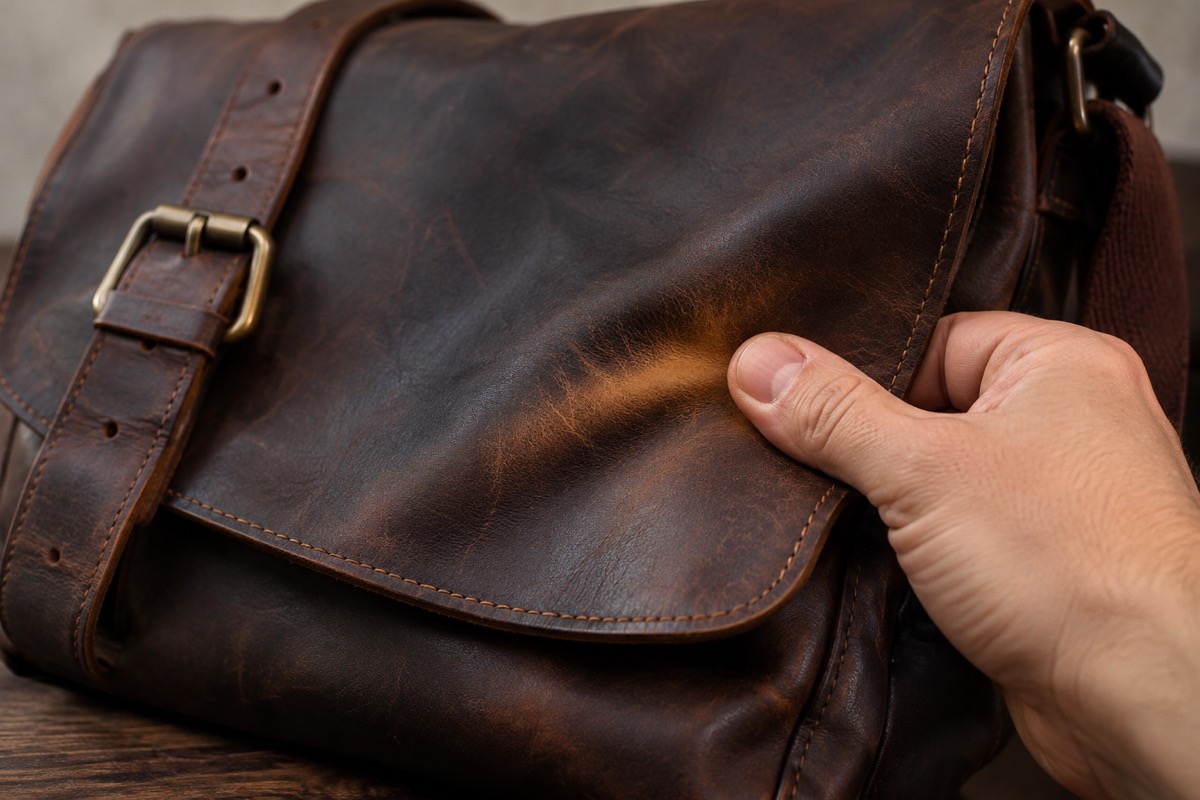
Pull-up leather is hide, usually cowhide, that has had hot oils and waxes worked into it late in tanning. The surface stays matte and slightly greasy to the touch, it sheds water, and it turns lighter wherever it is bent or rubbed before the colour returns.
It is a treatment, not an animal and not a grade, and it shows up most on bags as the patina of leather forms. According to Stridewise, which quotes two leather professionals, pull-up is a finishing technique rather than a type of leather: any hide can be finished that way, and the effect is unrelated to whether the grain is full or corrected. Our product pages describe it in several ways: oiled, oiled and waxed, greasy and waxed, crazy horse. When a product page says oiled leather, it describes how the leather behaves, not a certification.
Is pull-up leather the same as oiled leather?
In practice, yes. Pull-up describes the visible effect, oiled and waxed describe what was put in the hide. The oils and waxes move when the leather is pulled, the area lightens, and body heat then spreads the wax back so the mark fades.
According to Beckett Simon, the same leather is also called waxed leather, wax pull-up, pull-up effect leather, oil pull-up leather or oiled leather. The names change from one maker to the next, the principle does not. On a product page, check the material line rather than the label alone. The most pronounced version has its own guide, what crazy horse leather is.
How is pull-up leather made?
Pull-up leather is made by forcing heated oil, wax or grease into the hide after tanning, then often dyeing the surface again. The fats coat the fibres, which is where the softness, the water resistance and the colour that moves come from.
According to Beckett Simon, hot oil emulsions and natural waxes are infused into the hide during tanning, and each cycle can take up to 6 weeks. According to Stridewise, this “hot stuffing” step comes after the hide has been softened and dyed at the tannery. Also according to Stridewise, the amount of oil and wax changes how strong the contrast is between the stressed area and the untouched leather.
Tanning itself is a separate topic, covered in vegetable-tanned leather. We do not know each tannery’s recipe. Our suppliers’ product pages say oiled, waxed or crazy horse without giving the oils or the duration, and we do not make them up.
How can you recognise pull-up leather?
You recognise pull-up leather by three signs: a matte, slightly greasy surface, a lighter area where you fold or pull the leather, and a fresh scratch that nearly disappears when you rub it with your thumb. Varnished leather or leather under a plastic film does none of this, and neither does PU leather.
- The fold test. Fold a corner: a lighter mark should appear, then fade within seconds or under your thumb.
- The scratch test. A fingernail leaves a pale line. According to Beckett Simon, the warmth and natural oils of your hand shift the wax again and the scratch diminishes; a deep scratch stays visible but blends into the look of the leather.
- The colour. According to Stridewise, black leather shows little contrast even when it is pull-up, because there is little colour to move. Browns show the effect best.
Beckett Simon also warns about a common confusion: synthetic leather coated with polyurethane has neither the breathability nor the movement of real pull-up leather and does not lighten under a fold. That is the simplest way to tell real pull-up from PU leather that only imitates the look.
What is the difference between pull-up, crazy horse, nubuck and full grain?
Pull-up describes the treatment. Crazy horse is a very pronounced oiled and waxed leather, full grain describes the outer face of the hide, and nubuck a sanded face. They are different axes: one bag can be full grain and pull-up, or nubuck with a pull-up effect.
- Crazy horse: the most visible version of pull-up, covered in our guide to crazy horse leather, from wax to care.
- Full grain: the outer face of the hide, kept intact. Our page on full-grain leather explains what it guarantees and what it does not.
- Nubuck: a sanded face with a velvety feel. According to Stridewise, some pull-up leathers are in fact heavily waxed nubucks. See what nubuck is.
- Vegetable tanning: yet another axis, the agent that tans the hide, explained in vegetable-tanned leather.
What it changes when you buy: if you want a bag that keeps its day-one look, choose a closed finish. If you accept that the leather records use, pull-up is the most expressive, and the patina of leather settles in faster than on a finished leather.
What do seven pull-up pieces from the catalogue measure?
The table reads each product page for the material and sizes it states. An empty cell means the page does not give the measurement: we do not work it out in the supplier’s place. The sizes come from the text of each page, read on 20 November 2026, with the usual one to three centimetre variation from one piece to the next. All sizes are in centimetres.
| Model | Stated material | Stated size | Other details |
|---|---|---|---|
| Commuter messenger bag | Full-grain cowhide impregnated with oils and waxes (crazy horse) | About 35 x 25 x 8 cm | A4 folder flat, tablet; dark brown or aged brown |
| Messenger bag with patch pockets | Crazy horse cowhide, oiled and waxed leather | About 35 x 28 x 13 cm | Two front pockets with buckles; tablet, notebook |
| Vintage satchel, two buckles | Real leather, oiled and shaded crazy horse finish, polyester lining | 26.5 cm wide, 10 cm deep | Tablet up to 7.9 inches, no laptop; height not stated |
| Laptop briefcase, 15.6 inches | Crazy horse cowhide, greasy and waxed, polyester lining | 40 cm wide | Laptop up to 15.6 inches; removable strap; five colours |
| Flat-back backpack | Oiled full-grain leather, crazy horse | 42 x 29 x 10 cm | Separate laptop compartment, cotton-lined |
| Small shoulder bag | Leather called oiled horse hide, described on the page as cowhide treated with oil | 23 x 20 cm | Flap closure, no zip |
| Oiled and waxed wallet | Cowhide oiled then waxed | Not stated in the text read | Short, bifold; version with RFID blocking |
What the sizes show: pull-up appears across the range, from the wallet to the backpack, and the slimmest piece whose thickness is stated is the commuter messenger bag at 8 cm, while the patch-pocket one reaches 13 cm at the same 35 cm width. None of these pages has been ordered yet: the table describes stated products, not field feedback.
How do you care for pull-up leather?
Pull-up leather needs little care: a dry cloth day to day, your thumb on a fresh scratch, and a balm or wax once or twice a year. The fats are already in the hide, so over-conditioning softens the pull-up effect and darkens the colour.
According to Stridewise, pull-up is low maintenance: a clean and a light conditioner about twice a year is enough, and one professional only conditions his own when it is really dry, because conditioning too often speeds up the evening-out of the colour. According to Beckett Simon, strong degreasing detergents damage this leather.
- Wipe dry, or with a barely damp cloth, without scrubbing.
- For a fresh scratch, rub with your thumb: the warmth moves the wax back.
- Once or twice a year, or when the leather is dry, apply a thin coat of leather balm with mink oil and beeswax. It is the care product that has already found a buyer.
- Let it dry flat after rain, away from a radiator.
Our messenger bag pages give the same advice: a wax for oiled leather once or twice a year, and no smooth-leather cream, which freezes the waxed effect. For the full routine, see how to condition leather.
Is pull-up leather waterproof?
Pull-up leather is water-repellent, not waterproof: oils and waxes shed rain and splashes, but seams and the opening let water through in a long downpour. Dry the bag flat and do not heat it. The difference between the two words is explained in water-resistant vs waterproof.
The oiled and waxed wallet’s page says the leather tolerates a damp contact that a plastic-finished leather does not. According to Stridewise, pull-up is not the most waterproof leather either: for site work, a silicone finish suits better.
Which model should you choose?
For everyday pull-up leather, start from what you carry. For an A4 folder and a tablet, the 35 x 25 x 8 cm messenger bag is the slimmest. For a 15.6-inch laptop, the briefcase states the room. For a phone and a wallet, the small shoulder bag is the most compact. The men’s leather shoulder bags collection lists every model in stock, with colours and current prices.
In short
Pull-up and oiled leather are one treatment under two names: fats in the hide, an effect that lightens at the fold, little care and a quick patina. It suits anyone who accepts that leather keeps the mark of use. See the commuter messenger bag, the 15.6-inch briefcase and the leather balm.
Questions
Is pull-up leather real leather?
Yes, pull-up leather is real hide treated with oils and waxes. It differs from PU leather, a coated synthetic base that does not lighten under a fold. Check the material line on the product page rather than the finish name.
Is oiled leather the same as greasy leather?
In practice, yes: greasy leather is leather loaded with fats, like oiled leather. “Greasy and waxed” and “oiled and waxed” describe the same idea, with a wax on the surface that protects. The pull-up effect is the visible result.
Does pull-up leather scratch easily?
Yes, it scratches easily, but the scratch mostly repairs itself: rub it with your thumb and the wax moves back. According to Beckett Simon, it handles scuffs better than many other leathers. Deep scratches stay visible and become part of the look.
What is the difference between pull-up and oiled leather?
None in substance: pull-up is the effect, oiled is the treatment. According to Stridewise, it is a finish, not a type of leather, and it exists on several hides and several faces of the hide.
Should you oil a pull-up leather bag?
You should rarely oil a pull-up leather bag, because it already holds its fats. A balm or wax once or twice a year, or when it is dry, is enough, according to our product pages and Stridewise. Too much product evens out the colour and erases the contrast.
Sources
- Beckett Simon, “What is Pull-Up Leather?”: https://www.beckettsimonon.com/blogs/resources/what-is-pull-up-leather, read on 20 November 2026.
- Stridewise, “What Is Pull Up Leather, Anyway?”: https://stridewise.com/what-is-pull-up-leather/, read on 20 November 2026.
