
Guides & Advice
Wallet Sizes: Formats, Card Capacity and Thickness
Sep
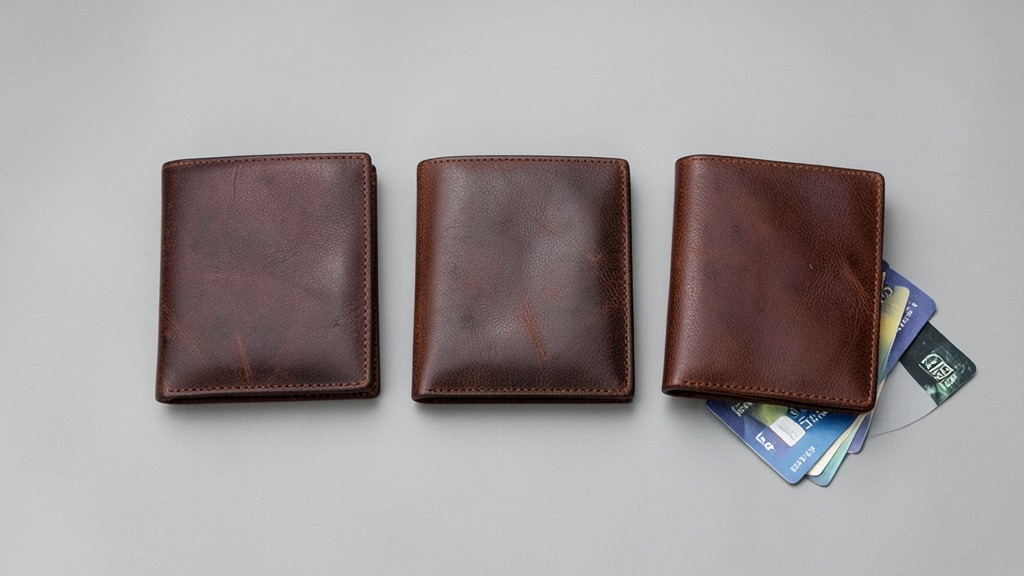
What are the usual wallet sizes, and which one fits the way you actually carry? Wallet sizes are decided by format before centimetres: a bifold, a trifold, a zip around and a slim money clip differ in thickness and in where they can live. This guide gives the common dimensions, the honest card capacity of each format, and the rule that prevents the usual mistake. Every model in our mens leather wallets lists its measurements.
Common wallet sizes, format by format
| Format | Folded size | Cards before it bulges |
|---|---|---|
| Slim, money clip | about 10 x 7 cm | 3 to 6 |
| Bifold | about 11 x 9 cm | 6 to 8 |
| Trifold | about 11 x 9.5 cm | 8 to 12 |
| Zip around | about 12 x 10 cm | 8 to 12 |
| Long, notes flat | about 19 x 10 cm | 10 to 14 |
Makers vary by a few millimetres, but the gaps between formats stay constant. Only the long format carries a note without folding it, and only the long format refuses to sit in a jean pocket. Our leather shoulder bags for men take it without complaint. For how each format behaves in use, see our guide to the different types of wallets.
The rule that prevents the usual mistake
Count the cards you actually carry, not the ones you might. Six cards fit every format. Twelve force a trifold or a zip around. Overfilling does not make a wallet bigger, it makes it thicker, and thickness is what destroys the fold.
The second question is the pocket. Front trouser pocket takes a slim or a bifold. Inside jacket pocket takes everything except a loaded zip around. A bag makes the long format viable, and our guide to full grain leather explains why a flat wallet ages better.
Thickness: the number nobody publishes
Listings give length and height, almost never thickness, which is exactly what shows through a pocket. An empty bifold runs about 1.5 cm. Loaded with eight cards and notes it approaches 3 cm. A trifold starts near 2 cm and passes 4 cm when full.
The progression is not linear. The first cards sit in their slots; the next ones spread the leather apart. Going from eight to twelve cards costs more thickness than going from four to eight. The leather matters too, and our article on crazy horse leather shows a finish that records that tension at the hinge.
What wears out before the size matters
The fold, always, because it works every time the wallet opens. An overfilled wallet keeps it under permanent strain until the leather splits along the crease. The corner stitching goes next, when thickness pulls on the thread.
Bonded leather fails there within one to three years whatever size you choose, because the fault sits in the material rather than in the format. Our article on bonded leather covers that mechanism in detail.
Our take: we recommend choosing one format smaller than you think you need. A wallet bought for twelve cards ends up holding twelve cards and then deforming, while the same buyer with a bifold carries eight and never complains. The format constrains the contents, and that is what makes the leather last.
Measure the wallet you already carry
The only measurement that counts is your current wallet, closed and loaded the way you carry it, not the figure on a product page. Lay it flat, measure width and height to the millimetre, then thickness at the fullest point, usually the card slots. Those three numbers are what you compare against any listing, remembering that a new wallet gains one to three millimetres after a few weeks of use.
Second useful measurement: the pocket it has to live in. An inside jacket pocket opens around 12 to 13 cm, a front jean pocket 11 to 12 cm. A wallet wider than the opening works its way out every time you sit down. It is the most overlooked criterion, ahead of card capacity, and the same logic applies when choosing a bag.
How many cards, realistically
| Format | Slots advertised | Comfortable in practice |
|---|---|---|
| Flat card holder | 3 to 6 | 3 to 4 cards and a few folded notes |
| Bifold | 6 to 10 | 6 to 8 cards without bulging |
| Trifold | 9 to 15 | 8 to 12 cards, but double the thickness |
| Zip around | 8 to 14 | the full count, at the cost of volume |
One slot takes one card. Forcing two bows the leather and damages the chip over time. Count the cards you use weekly, add two, and leave the rest in a drawer or a second leather wallet kept for travel.
Size and sitting comfort
A wallet carried in a back pocket tilts the pelvis as soon as it passes a centimetre and a half in thickness. Sitting on it for hours a day sustains an imbalance that back specialists see regularly. Two practical answers: switch to a card holder in the front pocket, or keep the wallet in an inside jacket pocket or a shoulder bag.
For mixed use, the bifold stays the best compromise: flat enough for the front pocket of straight trousers, capable enough for everyday cards and notes.
Less common formats, and who they suit
- Pop up card holder: a lever fans the cards out. Very flat, but limited to four or five rigid cards.
- Money clip wallet: notes held by a spring or magnet. The thinnest format, with no room for coins.
- Long, continental wallet: takes notes flat, unfolded, and rides in an inside jacket pocket.
- Zip around: nothing falls out, at the cost of slower access and more bulk.
- Passport holder: a travel format, built around a passport and boarding passes rather than daily carry.
Format follows use, not fashion: a continental will not sit in a jean pocket, and a money clip suits nobody who keeps coins. Our range is grouped under men’s leather wallets.
Breaking a new wallet in
A new wallet is always tighter than it will be. Leather card slots stretch to their final size within two to three weeks of daily use, so a card that goes in stiffly at first will slide later. Do not force the fit by pushing two cards into one slot in week one: that stretch is permanent and the slot never grips again.
Fold the wallet closed overnight with the cards you intend to carry inside, and leave the notes out for the first few days. The fold line settles, the spine takes its curve, and the whole piece loses one to two millimetres of apparent thickness. From then on, the measurements you took at the start hold, whichever leather wallet you chose.
Our selection: wallets and leather goods
- Mens leather wallets, every format, measurements listed.
- Mens briefcases, when the long format comes along for the ride.
- Leather messenger bags for men, same family of hides.
Conclusion
Choose the format from the number of cards you really carry and from the pocket it will live in, then check thickness rather than length. Six cards go anywhere, twelve demand a trifold or a zip around. Browse our mens leather wallets or read our guide to full grain leather.
Frequently asked questions
What is the standard wallet size for men?
The bifold, around 11 x 9 cm folded, remains the most common. It holds six to eight cards without thickening.
How many cards fit in a wallet?
Three to six in a slim format, six to eight in a bifold, eight to twelve in a trifold or a zip around.
Will a long wallet fit in jeans?
No. At roughly 19 cm it belongs in an inside jacket pocket or a bag.
Why is thickness never listed?
Because it depends on the contents. Reckon on about 1.5 cm for an empty bifold and close to double once loaded.
Do leather wallets stretch over time?
The card slots relax slightly over the first months, then settle. The fold does not stretch, it wears.
Which wallet size is best for travel?
A zip around, because it closes completely and keeps boarding passes and receipts from escaping in a bag.
