
Guides & Advice
Ostrich Leather: How to Spot It, What It Costs and Care Tips
Oct
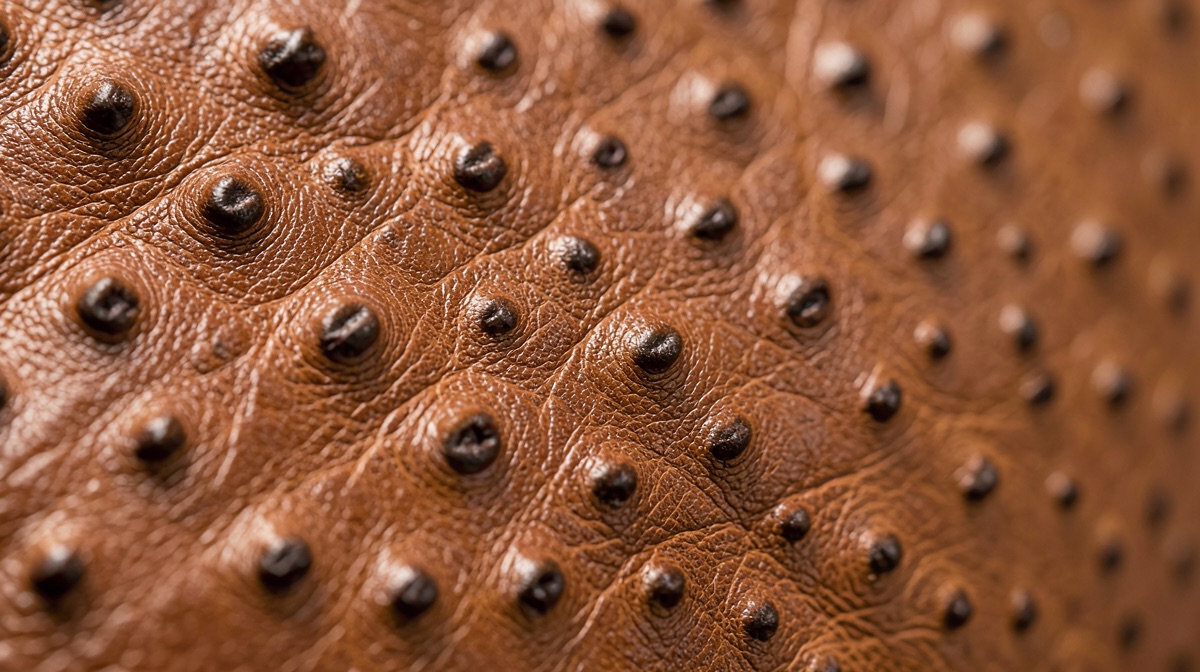
Ostrich leather is the exotic hide you recognize by its quill bumps, the small raised dots left where the feathers grew. It ranks among the most sought after skins in luxury leather goods because it is soft, tough and scarce at the same time. You will mostly see it on high end handbags, wallets, belts and western boots. Before you pay a premium for an ostrich piece, it helps to know how to tell the real hide from an embossed lookalike, and what the leather asks of you once you own it. If you are shopping for a fine leather bag right now, start with our men’s leather bags. Below: what ostrich leather actually is, how to identify it, what it is worth on a bag and how to care for it.
Contents
- A farmed hide with a pearled grain
- How to tell real ostrich leather
- What ostrich leather is worth on a bag
- How to care for an ostrich leather bag
- The exotic grains in our catalog
- Frequently asked questions
Ostrich leather: a farmed hide with a pearled grain
Ostriches are farmed mainly in South Africa, around the town of Oudtshoorn in the Little Karoo region. The hide is a co-product of that farming, which also supplies meat and feathers. Once tanned and dyed, it turns into a leather that looks like nothing else: on the bird’s back, where the feathers grew, every follicle leaves a small round bump. That area, often called the crown or full quill section, is the most valuable part of the skin because the quills there are dense and evenly spread.
The rest of the hide is smoother, with scattered quills or none at all along the flanks. The legs give a completely different leather, covered in scales rather than bumps, known as ostrich leg leather, which looks closer to reptile. A single skin therefore yields several looks, and only a small portion of it carries the full pearled pattern. That scarcity is one of the main reasons ostrich commands such a high price.
Ostrich belongs to the family of exotic leathers, alongside crocodile, alligator, python and lizard. Each of them is valued for a surface that no cowhide can grow naturally, and each one ages in its own way. To place ostrich among the other hides and finishes, our guide to the types of leather compares cowhide, calfskin, lambskin, goatskin and exotic skins side by side.
How to tell real ostrich leather from an imitation
The pearled grain is easy to copy by embossing: a heated plate presses the pattern into cowhide or into PU leather. The result can look very good, but it is not ostrich, and the price should reflect that. Four clues help you tell them apart in a shop or from close up photos.
- Irregular quills: on a real hide, their size and spacing vary, they cluster toward the center and thin out toward the edges. An embossed panel repeats the same pattern at fixed intervals across the whole surface.
- A tiny pit at the top of each bump: a genuine quill often shows the mark of the follicle. Embossed bumps are smooth and identical.
- Smooth patches between the bumps: real ostrich alternates quilled areas and plain ones. An imitation usually covers the entire bag with a uniform texture.
- The feel: genuine ostrich is supple and slightly oily under the fingers, and the bumps stay soft when you flex the leather.
| Clue | Genuine ostrich leather | Ostrich embossed leather |
|---|---|---|
| Quill layout | irregular, denser in the center | identical repeating pattern |
| Top of each bump | often a small follicle pit | smooth bump |
| Plain areas | present, mostly toward the edges | rare or missing |
| Base material | tanned ostrich skin | cowhide or PU leather |
| Price | among the highest in leather goods | close to the base material |
A seller who uses vague wording such as “ostrich print” or “ostrich look” is describing an embossed leather, which is perfectly honest as long as the base material is named. The same logic applies to every raised grain: our article on pebbled leather explains natural grain versus printed grain, and our guide on how to tell real leather covers the edge, smell and touch tests.
What ostrich leather is worth on a bag
Ostrich owes its reputation to a rare balance. The hide is known for its natural oils, which keep it supple and help it resist cracking over the years. It handles repeated folding well, which makes it a favorite for soft bags and wallets. The big fashion houses keep it for their most exclusive pieces: Hermès, for instance, offers some Birkin and Kelly bags in ostrich, and our guide to men’s leather bags shows the everyday alternatives in cowhide.
Its limits are just as clear. Price comes first, which keeps genuine ostrich in the luxury tier. Water sensitivity comes next: a shower will not ruin it, but a drop that dries on a light color can leave a ring. Finally, its very marked look does not suit every style. A man who wants a discreet bag for the office will usually pick smooth or pebbled cowhide, while ostrich speaks to those who want a statement piece.
Against crocodile, the other prestige exotic, ostrich feels softer and lighter, with a dotted relief rather than scales. Against embossed cowhide, it offers a finer skin and an authentic grain, but costs far more for comparable everyday use. If you love the look but carry your bag daily in all weather, an embossed cowhide often makes more practical sense, and there is no shame in that choice.
How to care for an ostrich leather bag
Caring for ostrich leather follows the rules of any fine leather, with a lighter touch. The essentials come down to five habits.
- Dust it regularly with a soft, dry cloth, moving with the direction of the quills.
- Condition it once or twice a year with a balm made for exotic leathers or a neutral balm, in a thin layer.
- Test any product on a hidden spot before you apply it to the whole bag.
- Blot a water drop right away without rubbing, then let it air dry away from heaters.
- Store the bag stuffed with paper, inside a cloth dust bag, out of direct sunlight that fades the dye.
Avoid silicone sprays and household cleaners, which can leave a film on the quills and dull the natural sheen. For the basics, our guide on how to condition leather details products and frequency, and our article asking is leather waterproof explains how to protect a leather bag from rain without greasing it.
The exotic grains in our catalog
To be upfront: as of October 12, 2026, our catalog does not include any genuine ostrich piece. The exotic grains you will find in it are crocodile embossed leathers, on cowhide or on PU leather, and every product page names the base material. It is a practical choice rather than a prestige one: an embossed relief on cowhide gives you the character of an exotic leather on a bag you can carry every day.
- The croc grain cowhide crossbody bag, made for daily wear.
- The croc grain cowhide clutch, for evenings out.
- The crocodile embossed leather passport wallet, for travel.
- The long crocodile embossed PU wallet, light and easy going in the rain.
See all our men’s leather bags, or our real leather wallets for men.
In short
Ostrich leather is a farmed hide, recognizable by its irregular quills, supple and durable, but expensive and prone to water marks. Before you buy, look at how the bumps are laid out and at the exact material named on the label: an embossed cowhide is not ostrich. To compare with other hides, read our guide to the types of leather, and for a bag with character you can use every day, browse our men’s leather bags.
Frequently asked questions
Is ostrich leather durable?
Yes, it is one of the most durable leathers used in leather goods. Its natural suppleness limits cracking, as long as you condition it from time to time and keep it away from standing water.
Why is ostrich leather so expensive?
Each hide carries only a limited area of full quill grain, farming is concentrated in a few regions, and tanning an exotic skin takes specific skills. All three show up in the final price.
Can ostrich leather get wet?
A shower will not damage it, but a drop that dries can leave a ring, especially on light colors. Blot it as soon as you can and let it dry at room temperature.
How can I tell if an ostrich bag is fake?
Look at the quills: regular, identical and smooth bumps point to embossing. A real hide shows bumps of varying sizes, plain patches and often a tiny pit at the top of each bump.
What is ostrich leg leather?
It is the leather taken from the bird’s legs. It is covered in scales instead of quills and is used mostly for boots, watch straps and small leather goods.
