
Guides & Advice
What Is Split Leather? Grades, Suede, Care and Real Uses
Oct
What is split leather? It is the lower layer of a hide, the part left once the tanner splits the hide in two through its thickness. The top layer keeps the grain and becomes top grain or full grain leather; the layer underneath, more fibrous and with no grain of its own, is the split. So split leather is real leather from the same animal, just not the same surface. You meet it everywhere: as suede on shoes and jackets, coated on belts and small leather goods, or hidden inside the structure of a bag. Before buying a men’s leather belt or a wallet, knowing how to read the word “split” saves you from paying full grain prices for something else, and from turning down an honest leather that does its job well.
What split leather actually is
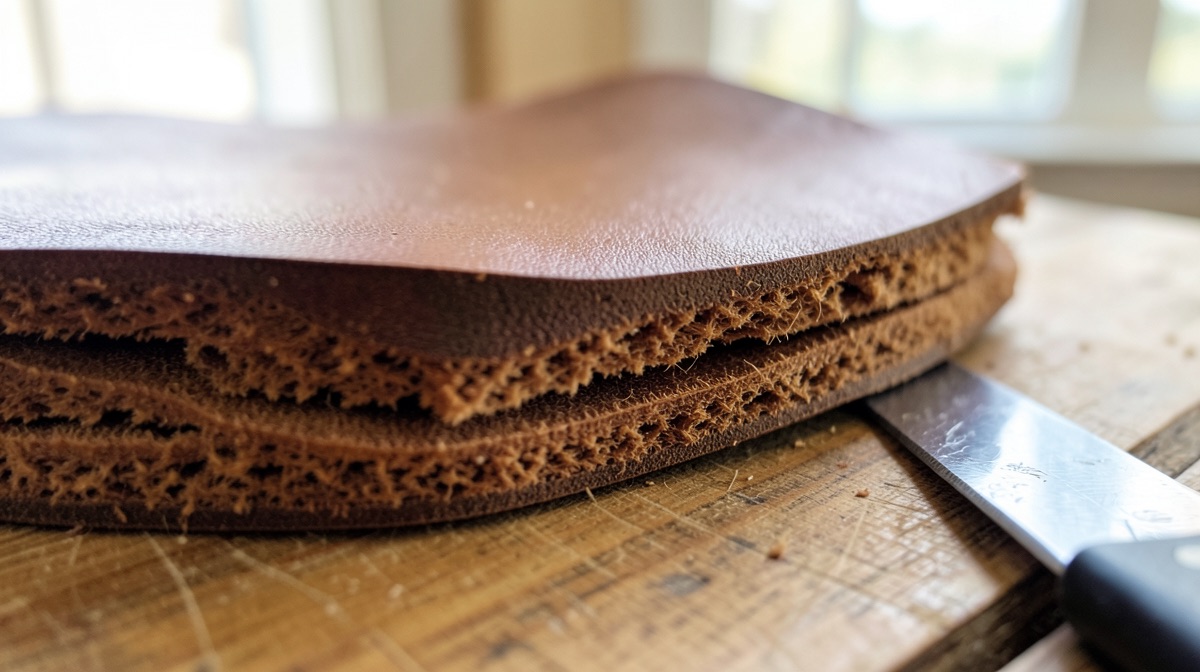
A raw cowhide is too thick for leather goods: several millimetres, with a tight grain side and a loose flesh side. After tanning, a splitting machine slices it horizontally, the way you would cut a bread roll in half. The top slice keeps the grain, the original surface with its pores, wrinkles and texture. The bottom slice is the split. A thick hide can yield one split or several, each further from the surface and each a little weaker.
Split leather therefore has no grain of its own. Its fibres are looser and more open than those of the grain layer, which makes it supple but less resistant to tearing and abrasion. That is why it almost always gets a finish: buffing that turns it into suede, or a film that gives it a smooth face. Our guide to the types of leather places split leather among the other grades, from full grain to bonded leather.
Split leather vs full grain leather
The question is not which one is “real leather”: both are. The difference is the layer of the hide, and it shows with use.
| Feature | Full grain | Split leather |
|---|---|---|
| Layer of the hide | original surface, grain intact | lower layer, no grain |
| Look | visible grain, natural marks | suede nap, or a smooth face from a coating |
| Strength | highest, tight fibres | lower, looser fibres |
| Ageing | develops a patina and darkens | keeps its look, no patina |
| Consistency | varies from piece to piece | very even from one item to the next |
| Price | highest | clearly lower |
Full grain is worth it on pieces you want to see age, a messenger bag or a satchel you will carry for years; our page on full grain leather explains what makes it valuable. Split leather makes sense on an item you want consistent and easy to live with, without watching how it ages.
Split leather and “genuine leather” labels
In the United States, the words “genuine leather” on a belt or a wallet often point to split leather, sometimes coated and embossed with an artificial grain. The label is not a lie, since split leather is genuine hide, but it is not a quality grade either. The ranking most shoppers use runs from full grain, to top grain (a grain layer that has been sanded and refinished), to split and “genuine” leather, and finally bonded leather. Our comparison of full grain vs top grain leather covers the top of that ladder in detail.
Suede split, coated split and plain split
One split can become materials that look nothing alike. Three finishes dominate:
- Suede split. The split is buffed to raise its fibres and give a soft nap. This is the material of most shoes and jackets sold as suede. It is not nubuck, which is buffed grain leather: our page on suede vs nubuck shows how to tell them apart.
- Coated split. A pigmented film, often polyurethane, is applied to the surface and sometimes embossed with a grain pattern. The result is smooth, water repellent on the surface and very even, but it no longer breathes like a grain layer.
- Plain or lightly finished split. It keeps a look close to nubuck, soft in the hand, and is used for small leather goods.
Suede split is cleaned like any suede: crepe brush, eraser and never too much water, as our guide on how to clean suede explains.
Split leather, bonded leather and PU leather
Three materials often share a label, and they have nothing in common. Split leather is a whole layer of hide with its original fibre structure. Bonded leather is made from leather scraps and fibres that are shredded, bound together and pressed into a sheet: it contains leather but is no longer a hide. PU leather is a synthetic material on a fabric backing, with no animal fibre at all, and its own strengths: consistency, wipe clean care, no patina. On a product page, “split leather” therefore means real leather. Our method to tell real leather from imitation helps you check by hand.
How to spot and care for split leather
- the cut edge shows looser, lighter fibres than a grain layer;
- a coated surface is perfectly uniform, with no pores or fine wrinkles;
- on suede split, the back looks like the front, while buffed grain keeps a rougher back;
- at the same size, the price is noticeably lower than full grain.
Care is simple: a damp cloth for coated split, a dry brush for suede. The finish dislikes alcohol and household cleaners, which bleach it in patches. After rain, let it dry flat, away from a radiator. Rich creams made for grain leather, described in our guide on how to condition leather, barely penetrate a coated film, so use them sparingly.
Our split leather pieces
On our catalogue, the words “split” or “split leather” are stated plainly on the product pages concerned:
- a 3.8 cm split leather belt with a riveted pin buckle sized for jeans loops, in coffee brown or matt black. See the split leather belt;
- a pop-up card holder wrapped in velvety split leather around an RFID blocking metal case of about 10 x 6.3 cm. See the split leather pop-up wallet;
- to compare with full grain, see our real leather wallets.
In short
Split leather is real leather taken from the lower layer of the hide. It costs less, stays consistent and does not patina, but it is less durable than full grain. Choose split for a belt or an everyday accessory, and full grain for a piece you want to see age. To compare materials piece by piece, browse our men’s leather belt range.
Frequently asked questions
Is split leather real leather?
Yes. It comes from the same hide as full grain, just from its lower layer. It is not synthetic like PU leather, and not shredded like bonded leather.
Is split leather durable?
It resists tearing and wear less than grain leather because its fibres are looser. For a belt or a wallet it handles daily use well; for a heavily loaded bag handle, grain leather is the better choice.
Is suede the same as split leather?
Most suede sold today is split leather buffed to raise a nap. Suede can also be made from thin hides such as goat or lamb, but on everyday shoes and jackets it is usually cow split.
Is split leather waterproof?
Suede split soaks up water and marks easily, so a suede protector helps. Coated split repels water on the surface; just wipe it and let it dry flat.
