
Guides & Advice
What Is Patent Leather: How It Is Made, Care and Limits
Sep
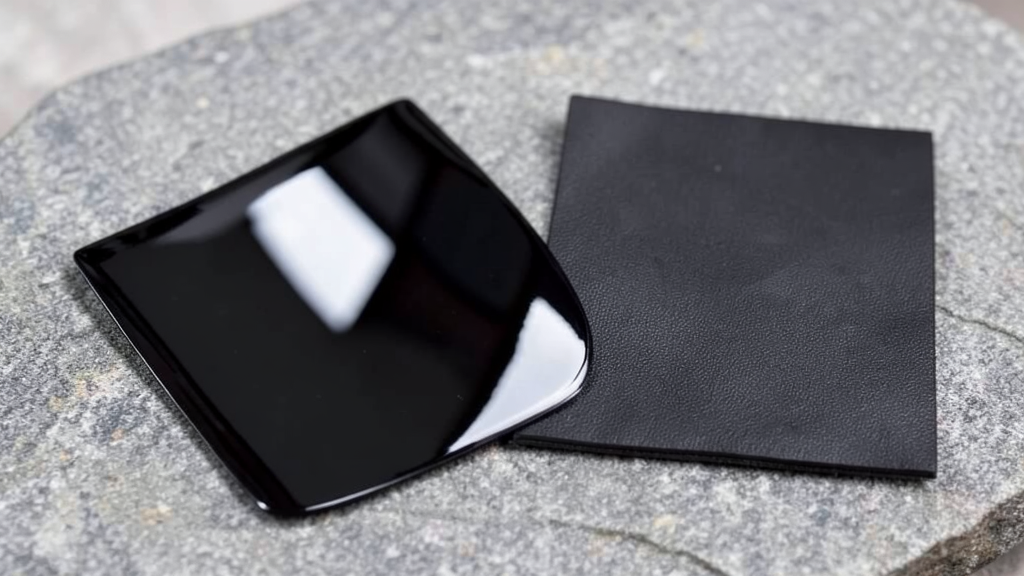
What is patent leather? It is leather covered with a glossy coating, once made from linseed oil and today from plastic resin, which gives it a mirror finish and makes it almost waterproof. It is the leather of evening shoes, dress belts and some handbags, but hardly ever that of a leather shoulder bag for men meant for daily use.
How patent leather is made
The historical process applied several coats of boiled linseed oil to a hide, then dried them in the sun. Modern versions use a polyurethane or acrylic resin sprayed onto corrected grain or split leather. The shine therefore does not come from the leather itself but from its coating, which sets it apart among the types of leather.
Its strengths
- An intense shine that needs no polishing.
- A barely porous surface that resists rain and stains.
- Minimal care: a damp cloth is enough.
- Bold, even colours across the whole piece.
Where full grain leather develops a patina and changes, patent leather keeps exactly its original look as long as the coating holds.
Its limits, especially on a bag
The coating does not breathe or stretch like leather. Where it bends often, it eventually cracks, and a crack cannot be repaired. It also scratches easily, shows fingerprints and can stick to other materials in strong heat, sometimes transferring colour. On a bag worn against the hip every day, these flaws appear quickly. It suits a mens clutch bag carried by hand for an evening out.
Patent leather and PU: a common mix up
Many glossy items sold as patent are in fact PU leather, a textile backing coated with polyurethane. The difference is not always visible head on, but it shows at the cut edge: patent over leather reveals a fiber layer under the film, PU shows an even textile. Price and label give a second clue.
The mix up is not dramatic, since both materials are cared for the same way and both scratch easily. It matters for lifespan: a PU film peels away in patches after a few years, where patent over leather crazes without detaching. Our article on PU leather covers that material, often unfairly dismissed.
Buying patent: three checks
Run these before you pay, on any patent piece, including the ones in our clutch bag range.
- Look along the surface at a low angle: a good lacquer reflects a straight line without ripples. Waves mean an uneven coat that will craze early.
- Flex a corner gently: the film should follow the hide without whitening. A white crease line is a warning.
- Check the edges and seams: this is where lacquer lifts first, so look for clean, sealed edges rather than raw ones.
What patent leather is actually for
Patent has one job: to reflect light. It is an evening, ceremony and uniform material, born for dress shoes and formal belts. On an accessory it creates a sharp contrast with matte cloth, a suit or a wool coat, and it gets noticed immediately, which is exactly the point.
That quality is also its limit. A patent piece never goes unnoticed, and it sets the tone of an outfit. A patent portfolio in an office draws the eye, where a matte leather messenger bag blends into professional dress. Patent works best as an accent, on a small piece, rather than across a large panel.
Caring for patent leather without dulling it
Patent leather is never conditioned: the lacquer stops any cream from soaking in, and a greasy balm leaves a sticky film that attracts dust. Care comes down to three habits. A soft dry cloth after each use, to lift the dust that scratches. A barely damp cloth for marks, wiped dry straight away. And twice a year, a dedicated patent leather milk, or a trace of white petroleum jelly spread very thin, to bring the shine back.
What to avoid: anything with alcohol or solvent, which clouds the lacquer, and storing the piece pressed against dyed leather, whose color can migrate. Keep a patent bag in a cotton dust bag, on its own, never squeezed against other pieces. For ordinary hides the rules differ, as our guide on how to condition leather explains.
Damage that cannot be undone
- Scratches go through the lacquer and leave a matte line. Nothing closes them; only a leather shop can relacquer the area.
- Crazing appears at the folds after some years, especially on a bag stored folded or in the cold.
- Color transfer: dark denim can tint light patent, often permanently.
- Sticking: two lacquered surfaces pressed together in heat can bond and tear on separation.
These limits are why patent stays a dress material, worn occasionally. For everyday carry, full grain or a classic leather messenger bag takes commuting far better.
Patent, glazed or waxed: the vocabulary
Three words cover neighbouring finishes. Patent leather carries a polyurethane film over the grain, mirror bright. Glazed leather is pressed smooth under heat, shiny but with nothing added: it still breathes and conditions normally. Waxed leather owes its shine to surface waxes, revived with a cloth.
You can see the difference in the light: patent throws a sharp reflection like glass, glazed and waxed scatter it. You feel it too, patent being colder and slicker. The distinction matters at purchase, because it changes care and lifespan entirely, much as it does for nappa leather, soft but easily scratched.
What our catalogue shows
Out of the 1,109 products in our shop, none is made of patent leather. Our bags are worn crossbody and flex with every move, and a patent coating would crack in the same places within months. Instead we offer leathers that improve with use, cowhide on 38 products and full grain on 33, plus PU leather on 84 products for those who want a smooth, even surface. For a dressier look, see our designer mens bags.
Storing patent leather
Keep each patent piece separately, in a cotton dust bag, never pressed against dyed leather or plastic, and away from heat. Slip acid free tissue between folded surfaces so the lacquer never touches itself. Stored that way, a patent bag from our clutch range stays glossy for years.
Our dressy selection
- Designer mens bags, for smart outfits.
- Mens clutch bags, carried by hand in the evening.
- Mens leather wallets, in smooth leather and Crazy Horse.
Conclusion
Patent leather owes its shine to a coating, not to the leather: it looks sharp, wipes clean and resists water, but it cracks at the folds. Keep it for dressy accessories you treat gently, and choose a more supple leather for an everyday bag. See our leather shoulder bags for men and our guide on how to condition leather.
Frequently asked questions
Is patent leather real leather?
Yes, the base is real leather. The glossy coating is synthetic, except on the rare fully plastic imitations.
How do you clean patent leather?
A soft, slightly damp cloth is enough, then a dry cloth to buff. Avoid solvents and alcohol, which dull the coating.
Can cracked patent leather be repaired?
Not really. A small crack can be hidden with a touch up varnish, but the coating does not re-form.
Is patent leather waterproof?
Its surface nearly is, but seams and edges let water through. It resists rain, not immersion.
