
Guides & Advice
How to Shorten a Belt: Leather, Ratchet and Canvas Belts
Oct
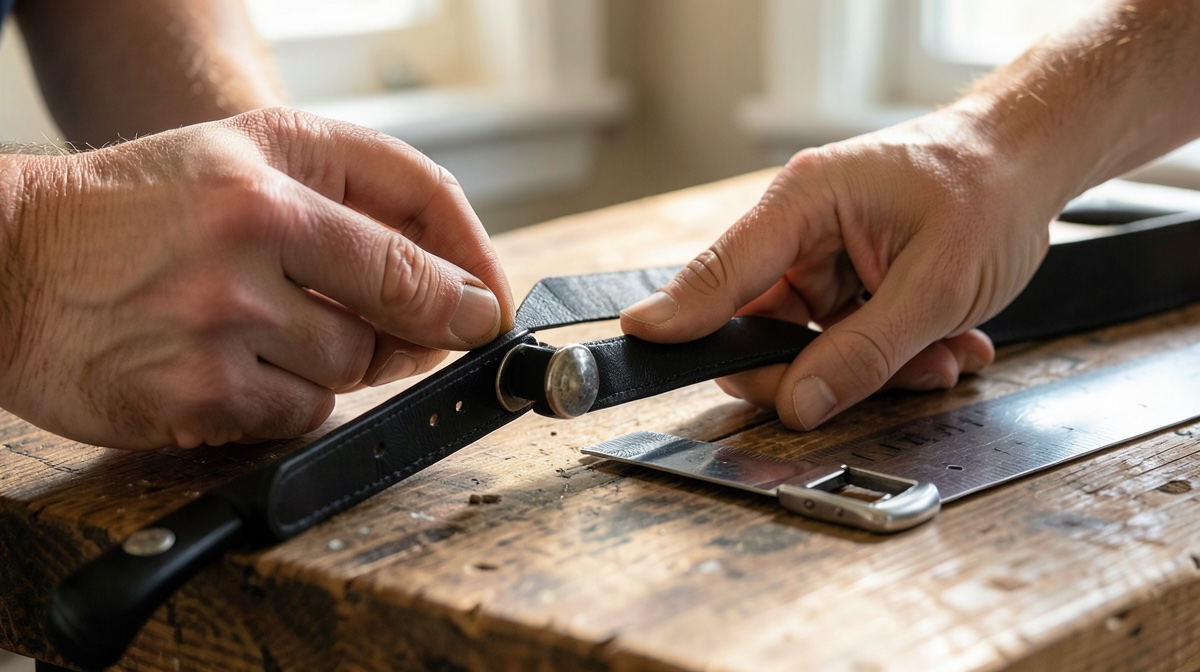
To shorten a belt, always cut from the buckle end, never from the tip: remove the buckle, cut the extra strap, then fit the buckle back. Everything depends on how the buckle is attached. A buckle held by screws, snaps or a clamp comes off in two minutes and you can do the job at home. A stitched or riveted buckle takes more care, or a visit to a cobbler. A ratchet belt is designed to be cut to length. This guide explains how to shorten a belt in each case, how to measure the right length first, and how to finish the cut edge so it does not fray. If you would rather buy a belt that already fits, our men’s leather belts list the length of each model.
Measure the right length before you cut
A cut cannot be undone, so the measurement comes before the tools. Buckle the belt over trousers you wear often, at the hole or notch that feels right, and mark with chalk where the prong goes in. On a classic belt, the right length puts that hole in the middle of the row, which leaves two holes of margin on each side. The loose end, past the buckle loop, should reach the first belt loop of your trousers without going much further.
Then measure how far the hole you use sits from the middle hole: that is the length to remove at the buckle end. Take off one centimeter, or about half an inch, less than that figure; you can always cut again. Our guide to belt sizes explains how a belt is measured and how its size relates to your waist.
Check how the buckle is attached
Turn the belt over at the buckle end and look at the back of the strap, where it folds around the buckle bar. You will find one of four set-ups:
- Screws: one or two flat screws go through the fold; a small screwdriver is enough.
- Snaps: the fold is held by press studs that open with a firm pull.
- Clamp: the buckle has a toothed jaw that bites into the strap, typical of ratchet belts.
- Stitching or rivets: the fold is sewn or riveted and the buckle was not meant to come off.
The first three can be shortened at home. The fourth needs a decision, explained below. Our guide on how to put a buckle on a belt shows each fastening in detail.
How to shorten a leather belt with a removable buckle
With a screw or snap buckle, the job takes about ten minutes and very little equipment: a small screwdriver, a metal ruler, a utility knife with a new blade, and ideally a leather hole punch for the fixing holes.
- Remove the buckle and keep the screws in a small dish.
- Lay the strap flat, back side up, on a cutting board.
- Measure the length to remove from the buckle end and draw a square line along the ruler.
- Cut in one clean pass, with the knife held straight against the ruler.
- Punch the screw or snap holes at the same distance from the edge as on the piece you removed: use it as a template.
- Refit the buckle and try the belt on before tightening the screws for good.
The fresh edge is pale and raw. A leather dye pen or edge wax brings back the color of the strap and stops it from fuzzing; a rub with a cloth is enough on an everyday belt. If the belt has been stretched at the same hole for years, this is also the moment to make a hole in a belt in the right place instead of enlarging the old one.
Stitched or riveted buckle: two options
When the buckle is sewn on, you have two routes. The first is to unpick the fold with a seam ripper, cut the strap, punch the slot for the prong, and sew the fold back with waxed thread and a saddle stitch, reusing the old needle holes when the length allows. It can be done with patience, but uneven stitching shows right away at the front of a belt.
The second route is a cobbler, who will usually shorten a belt in a few minutes, cut and stitching included, for a modest price. On a full grain leather belt you plan to keep for years, it is often the best choice. Never cut the tip end to avoid touching the buckle: you would lose the shaped tip and the row of holes, and the belt would no longer look right. Our leather belt range gives the length of every model if a new belt makes more sense.
How to shorten a ratchet belt
A ratchet belt has no holes: the strap moves notch by notch through the buckle and a lever releases it. It is shortened by cutting, which is the whole idea. On our product pages, the method is always the same:
- Open the buckle clamp, usually a small lever or bar to lift under the buckle, and pull the strap out.
- Wrap the strap alone around your waist, over your trousers, and mark where it should enter the buckle.
- Add a few centimeters, about an inch, of margin, then cut square.
- Push the cut end fully into the buckle and close the clamp.
Keep some margin rather than cutting tight: the track that locks the strap runs under it, and a strap cut too short leaves no adjustment after a meal. On our leather belt with an automatic buckle, the notches are about 5 mm apart, so a little margin gives you many settings. Our ratchet belts for men come in cowhide and PU leather.
Canvas, braided and elastic belts
A polyester or nylon webbing strap frays as soon as it is cut. Cut it with scissors, then pass the edge through a lighter flame for a few seconds to melt the fibers: they fuse and stay put. Cotton canvas does not melt, so fold the edge twice and stitch it, or seal it with fabric glue. A braided or elastic belt is shortened the same way at the buckle end, but the weave unravels quickly: have a cobbler do it if the buckle is stitched.
Leather remains the easiest material to cut cleanly, which is one reason a ratchet belt in leather or PU leather is so easy to fit at home.
Belts to compare
If the belt you want to shorten is too worn, or if you would rather buy one at the right length, these models state their width, length and how to cut them to size:
- See the cowhide ratchet belt with a cut to fit strap: 3.5 cm wide, brushed buckle that comes off for cutting.
- See the PU leather belt with an automatic buckle: 3.4 cm wide, three lengths, clamp to open for cutting.
- See the men’s leather belts: pin buckle belts with the length stated on each product page.
In short
Shorten a belt at the buckle end: measure on yourself, remove a little less than planned, cut square, refit the buckle and color the edge. With screws, snaps or a clamp, it takes ten minutes at home; with a stitched buckle, a cobbler is the safest route. A ratchet belt is cut to length by design, so keep some margin. To compare belts at the right length, browse our men’s leather belts.
Frequently asked questions
Can you shorten a belt without cutting it?
Only by adding a hole further along the row, which makes the loose end longer. That works for a centimeter or two; beyond that, the tip sticks out too far past the loop and you need to cut at the buckle end.
How much can you shorten a belt?
As much as you need, as long as you cut at the buckle end. The only limit is the loose end: enough strap must remain past the buckle loop to reach the first loop of your trousers.
How do you shorten a ratchet belt without damaging the buckle?
Open the clamp before you pull on the strap, never the other way round. Once the strap is cut, push it all the way in before closing the clamp, or the teeth will not bite properly and the strap will slip.
Can you shorten a PU leather belt?
Yes, exactly like a leather belt, at the buckle end. PU leather cuts cleanly with a utility knife, and a pen in the color of the strap is enough to finish the edge.
Should I shorten a belt myself or go to a cobbler?
Do it yourself if the buckle is held by screws, snaps or a clamp. Go to a cobbler if the buckle is stitched or riveted, or if the belt is valuable and you want an invisible finish.
