
Guides & Advice
How to Fix a Zipper on a Backpack Without Replacing It
Sep
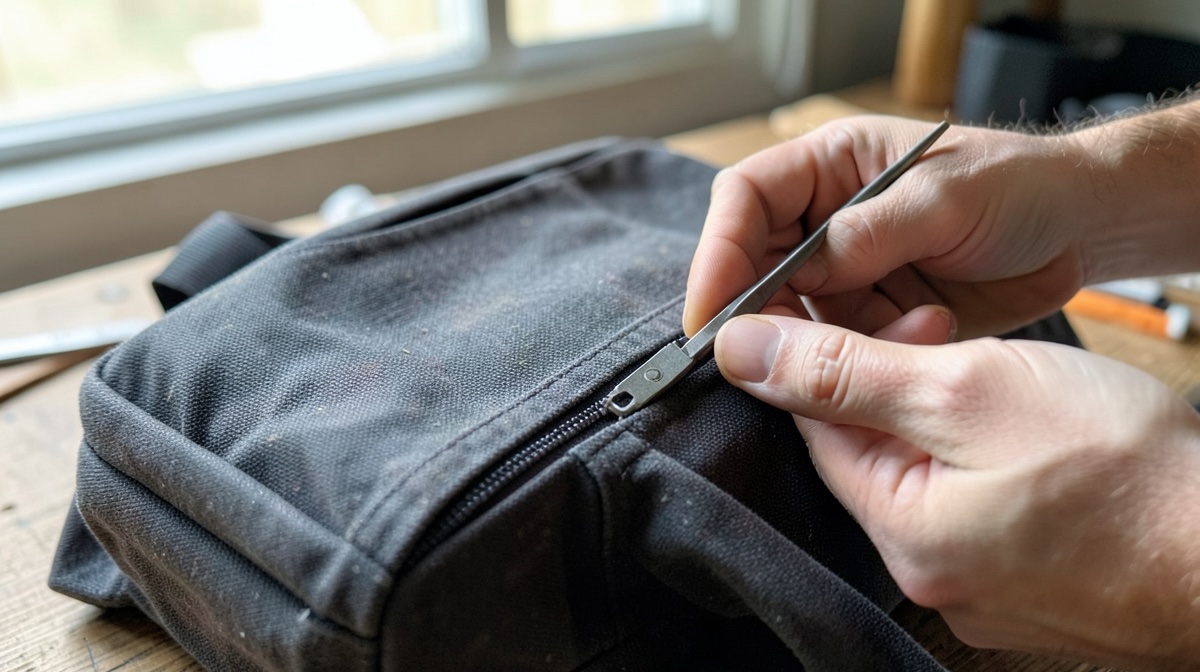
How to fix a zipper on a backpack without replacing it? In most cases the fault is not in the teeth but in the slider, the small metal piece that locks them together: a worn slider spreads open, stops pressing the two rows against each other, and the zipper gapes behind it. A pair of flat pliers, a bar of dry soap and ten minutes are usually enough to put it back to work. The other common failures, a slider that has come off one side, a broken pull tab, a zipper jammed on fabric, can also be fixed at home, and only torn tape or missing teeth call for a new zipper sewn in by a cobbler. This guide applies to any bag with a zipper, from a school backpack to a duffel, and if yours is genuinely beyond saving, our range of men’s rucksacks and backpacks is sorted by use.
Find the fault before you fix a zipper on a backpack
Look closely at the zipper before you pick up any tool. The symptom almost always tells you which part failed, and each part has its own fix. This table covers the five situations you will meet on a bag.
| What you see | Likely cause | Fix | Tool |
|---|---|---|---|
| The teeth reopen right behind the slider | Slider spread open by wear | Tighten the slider | Flat pliers |
| The slider holds on one side only | Slider came off one row of teeth | Feed the row back in | Pliers, sometimes a butter knife |
| The slider jams or moves in jerks | Fabric caught, dirt, dry teeth | Free it, then lubricate | Dry soap, candle wax or pencil lead |
| The pull tab is broken, the slider is fine | Tab or ring snapped | Fit a replacement pull | Clip-on pull, key ring |
| Missing teeth or torn tape | Damaged chain | Replace the whole zipper | Sewing machine or cobbler |
A coil zipper, the nylon spiral fitted to most backpacks, is forgiving: its coils snap back into place. A metal tooth zipper, more common on leather bags, is tougher, but a bent tooth does not always straighten. On a bag you open dozens of times a day, like the models in our men’s crossbody bags range, the slider is nearly always the first part to tire, because it works at every opening.
The zipper opens behind the slider: tighten the slider
This is the most common failure, and the easiest to fix. A slider is made of two plates joined at the front. After thousands of passes the plates spread by a few tenths of a millimeter and no longer press the teeth together hard enough. The chain looks closed, then splits as soon as the bag is under tension.
- Run the slider all the way down to the open position.
- With flat pliers, gently squeeze the back of the slider, the end where the closed teeth come out, one plate at a time.
- Squeeze lightly: a slider that is too tight will jam, and a cracked slider goes in the bin.
- Run the slider back up and pull the two sides of the bag apart to check that the chain holds.
- If it still opens, repeat and squeeze a fraction more.
My advice is to work in small steps. Most bag sliders are cast in zamak, a zinc alloy that snaps cleanly once you pass a certain pressure. Done properly, this repair lasts months and often much longer. On a bag you tend to overfill, such as a travel backpack for men, tension is part of the cause: packing tighter so the zipper is not strained keeps the slider from spreading again.
The slider came off one side: get it back on the teeth
Yank a zipper at the end of its run and the slider can leave one of the two rows of teeth. It then dangles on a single side and the bag will not close at all. As long as the slider is in one piece, it goes back on.
- If the bottom stop is reachable, run the slider to the very bottom, line up the two rows at the same height and move it up slowly: the free row feeds itself in.
- If the stop is sewn or welded, thread the free row into the slider’s mouth from the top, easing the plate open a hair with the tip of a butter knife, then tighten the slider as in the previous section.
- On a separating zipper, the kind used on a detachable pocket, simply push the pin back into the box at the bottom before zipping up.
The move is identical on large formats, from a weekender to the holdalls in our men’s travel bags range. Once the slider is back on, check that it does not come off again at the same spot: if it does, the top stop has been torn away, and a few tight stitches just above the last tooth replace it perfectly well.
The zipper is stuck or catches: free it without forcing
A zipper that jams is not broken, and forcing it is what breaks it. First check whether fabric, the lining or a loose thread is caught in the slider. If so, back the slider up a quarter of an inch while pulling the fabric the other way, without tearing it out. Tweezers help with a single thread.
If nothing is caught, the chain has simply lost its glide, usually after rain or a wash. Rub the teeth on both sides with a bar of dry soap, the end of a candle or the lead of a pencil, then run the slider back and forth ten times. Avoid cooking oil, which attracts dust. A bag you have just washed should dry with the zipper open; our guide on how to clean a backpack covers the settings that spare the zippers.
Broken pull tab or worn slider: replace the part
The pull tab, the little tongue you hold between your fingers, often breaks before anything else. If the slider is intact, a clip-on replacement pull goes on in seconds; in a pinch, a key ring, a paper clip or a loop of cord through the eye of the slider does the job. On bags with hidden zippers, like our anti-theft backpacks, a cord loop is actually easier to grab than the original tab.
When the slider itself is cracked or worn smooth, it has to be swapped. The one thing to check is its size: a number is stamped on the back of the slider, most often 3, 5, 8 or 10, which is roughly the width of the closed chain in millimeters. The new slider must carry the same number and suit the same chain type, coil, molded plastic or metal.
- Remove the bottom stop with cutting pliers, or unpick a few stitches.
- Slide the old slider off the end of the chain.
- Feed the new slider onto both rows, pull tab facing out.
- Run it up and down once to check, then sew a new stop with a few tight stitches.
When a repair is no longer enough, and how to avoid getting there
Two failures cannot be fixed with pliers: teeth torn out in the middle of the chain, and tape ripped along the teeth. In both cases the whole zipper has to be replaced. A cobbler or alterations shop will do it, and that is often wiser than replacing a bag you like, especially in leather, where the original stitching has to be followed hole for hole. For a leather shoulder bag, ask for a metal tooth zipper in the same gauge as the old one.
Here is what our own catalog says on the subject, checked on September 30, 2026 across our published product pages: 469 of 1,341 listings describe a zipper in their text, but only 4 name the maker YKK, and only 3 specify metal teeth. In other words, most bags on the market, ours included, do not tell you which zipper they carry. That is one more reason to know how to repair it yourself. Three habits make a zipper last:
- do not fill the bag to the point where you have to force the chain shut;
- hold the bag with one hand and pull the slider with the other, in line with the zipper;
- run a little dry soap or wax over the teeth once or twice a year.
Backpacks and bags to compare
If your bag really has reached the end of the road, these ranges group models with zippers suited to each use:
- See men’s rucksacks and backpacks: the widest choice, from city models to hiking packs.
- See waterproof backpacks: zippers shielded from rain.
- See laptop backpacks for men: wide openings so the computer comes out without straining the chain.
- See men’s crossbody bags: small zippers worked all day long.
In short
To fix a zipper on a backpack, start with the slider: tightened with pliers, fed back onto its teeth or replaced in the right gauge, it solves most failures. Torn tape or missing teeth, on the other hand, need a new zipper fitted by a professional. To look after the rest of the bag, read our guide on how to clean a backpack, or compare the models in our men’s rucksacks range.
Frequently asked questions
Why does my backpack zipper keep opening by itself?
The slider has spread with wear and no longer presses the teeth together. Squeezing its two plates with flat pliers, a little at a time, solves the problem in most cases.
Can you fix a zipper without replacing it?
Yes, as long as the teeth and the tape are intact. A spread, derailed or jammed slider can be repaired, and a broken pull tab is replaced on its own. Only missing teeth or torn tape mean the whole zipper has to go.
How do I know what size zipper slider I need?
Look at the back of the slider: a number is stamped there, usually 3, 5, 8 or 10. It matches the width of the closed chain in millimeters, and the replacement slider must carry the same number and suit the same chain type.
What can I put on a zipper that catches?
A dry lubricant: soap, candle wax, or pencil lead rubbed on both rows of teeth. Liquid oils attract dust and eventually gum up the chain.
Should a leather bag zipper be replaced by a professional?
Yes, as soon as the tape or the teeth are damaged. Every stitch in leather leaves a permanent hole: a cobbler reuses the holes of the original seam, which a home sewing machine rarely manages cleanly.
