
Guides & Advice
How to Soften Leather Without Cracking the Grain
Sep
How to soften leather comes down to two things nothing else replaces: fat and movement. Conditioner restores the lubricant the fibres lost, and flexing makes those fibres slide across each other again. Heat, hot water and dryers do the opposite, cracking the grain instead of relaxing it. The same routine works on a stiff leather messenger bag, on boots and on a jacket.
Contents
This guide follows the order of the work, from diagnosis to hand flexing, and hands over to our guide on how to condition leather for the upkeep that follows.
- Why leather goes stiff
- What actually softens leather
- The five step method
- Bags, boots, jackets and belts
- Methods that ruin the hide
- How long it takes, and what to expect
Why leather goes stiff
Tanned hide is a web of collagen fibres kept supple by oils introduced during tanning. Three things remove them: water, which carries them out as it dries, heat, which evaporates them, and time. Without that lubricant the fibres bond to each other, and the piece turns to cardboard.
Diagnose it by hand. Dry but healthy leather folds into wide creases that flatten out again. Dead leather folds into fine, whitened creases that stay, sometimes already cracked, and at that point you stabilise rather than recover. Whitening along the crease is the deciding sign, and it reads more clearly on full grain than on pigmented hide, where the finish hides the state of the fibre. Our guide on leather patina covers what healthy ageing looks like.
Storage matters as much as use. A bag left in a dry cellar or above a radiator for one winter loses its oils without ever being carried, and comes out stiffer than a bag used daily. Aim for around fifty percent humidity, in a cotton dust bag that breathes, never in plastic, which traps damp and creates the opposite problem.
New leather is its own case. Vegetable tanned hide arrives rigid by design, and it softens mainly through use. Forcing it with three coats of grease in week one leaves it limp and shapeless, which cannot be undone in the other direction.
What actually softens leather
| Product | What it does | Best for |
|---|---|---|
| Cream conditioner | light oil, does not darken | smooth, pigmented and pale hides |
| Neatsfoot oil, animal grease | deep feed, darkens noticeably | thick hides, boots, dark colours |
| Beeswax | softens little, protects a lot | a finishing step after conditioning |
| Coconut or olive oil | penetrates, then turns rancid | nothing, avoid entirely |
| Saddle soap | cleans and relaxes slightly | preparation before conditioning |
Colour decides the choice more than strength does. Grease darkens natural leather by a full shade and accelerates ageing, which is a pleasure on tan and a disaster on pale beige. When in doubt, a colourless cream and two passes beat grease and regret.
Quantity matters as much as the product. Use about a hazelnut for the area of a sheet of paper. Past that the hide stops taking it, the excess sits on top, turns tacky and collects dust. Leather that refuses its coat is saturated, not dry, and insisting only clogs the grain. The routine is set out in how to condition leather.
The five step method
- Clean with saddle soap on a barely damp sponge, then let it dry two hours. Conditioner over dust seals the dust in.
- Test on a hidden panel, under a tab or inside the base, and wait an hour to judge the colour shift.
- Apply a thin coat with bare fingers. Hand warmth drives the oil in where a cloth leaves it sitting on top.
- Let it absorb twelve hours at room temperature, never near a radiator.
- Work the piece: roll it, fold it, knead the stiff areas for a solid ten minutes. Everyone skips this step, and this step is what softens leather.
Two thin coats a day apart beat one heavy coat, which stays on the surface and goes tacky. On very dry leather, plan three cycles across a week. Between coats, keep a bag stuffed with paper so it holds its shape while the oil works. General upkeep is covered in how to clean a leather bag.
Room conditions change the result. At twenty degrees the conditioner melts and penetrates; in a cold room it sets on the surface and gives the false impression that the hide will not take it. If the piece comes out of a cold cupboard, let it sit an hour before applying anything.
The flexing deserves detail, because it is usually done wrong. Do not twist the piece. Fold it where it already folds in use, open and close the gussets, roll the strap between your palms. The goal is to unstick fibres from each other, not to force a new crease that becomes a permanent mark.
Bags, boots, jackets and belts
Suede and nubuck follow none of this. Their nap holds no finish to feed, so cream mats the fibres into shiny patches that no brushing lifts. Stiffness there is dirt and compacted nap rather than dryness, and the fix is a crepe brush plus a dedicated spray, never a conditioner.
A bag softens at its working folds: flap, gussets, strap anchors. Work those areas by hand and keep the body stuffed with paper so the shape survives the process. On a briefcase, the flap decides how comfortable the bag is to open, which is where the effort pays first, as our leather briefcase range is built around.
Boots stretch through wear and nothing else: twenty minutes a day with a thick sock, after conditioning, does more than any product. Cedar trees hold the result between wears and pull moisture out of the lining.
A jacket asks for patience only: a light feed at the elbows and shoulders, then regular wear. A stiff jacket relaxes in three to four weeks of normal use with no mechanical work at all.
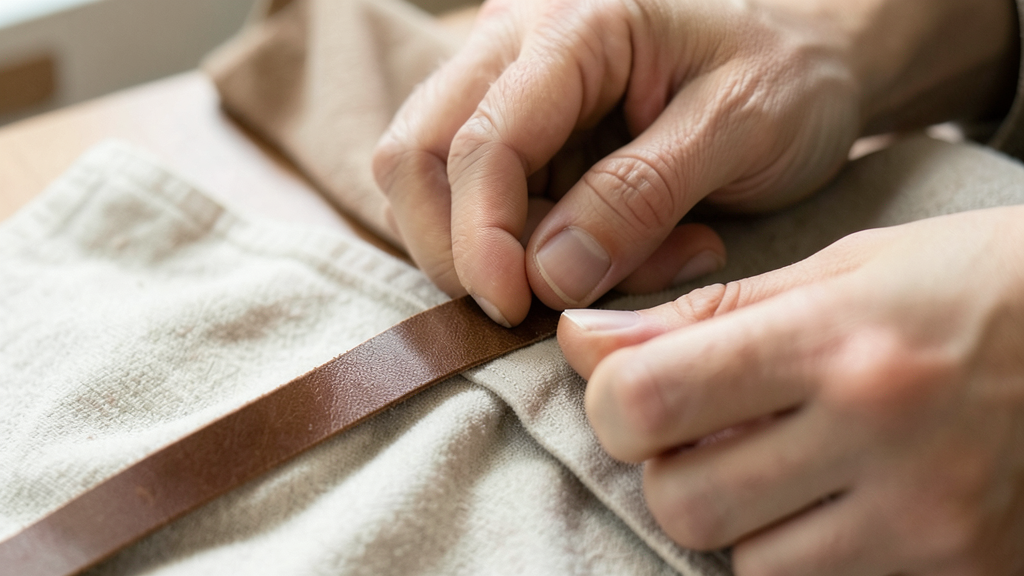
Belts and straps are where rolling gives the best return, being thin and working along their whole length. Small goods are the opposite case: wallets and card holders are so thin that oil bleeds through and stains the lining. A minimal smear with one finger, then forty or fifty folds, is the whole treatment, and a new leather wallet softens on its own within two weeks in a pocket.
Methods that ruin the hide
- Hair dryers and radiators: heat drives off the last oils and shrinks the grain, so the piece ends stiffer than it started.
- Hot water and soaking: they denature the tannage and leave the piece rigid, smaller and permanently creased.
- Washing machines: drum, heat and detergent combine all three mistakes at once.
- Rubbing alcohol: it dissolves the finish and bleaches the colour.
- Cooking oils: they absorb well, then go rancid, and the smell never leaves.
- Petroleum jelly on pigmented leather: it softens the finish film itself and leaves it tacky.
These circulate because they produce a visible result on the spot. Heated leather feels softer immediately: that is residual fat melting, and it evaporates within the day, leaving the fibre drier than before. Two more recipes deserve naming. Fabric softener is formulated for plant and synthetic fibres, brings no fat to collagen, and leaves a deposit that goes sticky in warmth. The freezer trick, sold for stretching shoes, expands the water inside the fibre and splits the grain from within without ever restoring suppleness. What a badly treated hide ends up with instead is set out in how to remove stains from leather.
How long it takes, and what to expect
Leather that is merely dry comes back in two or three cycles, roughly a week. New vegetable tanned leather takes one to three months of regular use, and that result lasts. Cracked leather does not come back: conditioning halts the decline and restores colour, it does not rebuild a severed fibre.
Of the 1,167 bags published on our site, 348 are leather, and the stiffness our customers ask about is almost always the first few weeks of a thick hide rather than a dead one. In that case the answer is daily use plus a single coat of cream, not a course of grease.
Measure instead of judging by feel. Fold the piece in the same spot before the first cycle and photograph the crease, then repeat after each cycle: crease width and how fast it flattens tell you what a hand stops noticing once it gets used to the leather. Three cycles with no visible change means the hide is finished, and it saves you a pointless fourth coat.
A valuable piece still stiff after three cycles goes to a leather specialist, who has rehydration baths that cannot be reproduced at home, for roughly twenty to sixty euros depending on size. On anything above a hundred euros of value, that maths is easy. Grades and how they age are compared in suede vs nubuck.
Bags that are soft on day one
- Leather messenger bags: corrected, supple hides with no break in period.
- Leather briefcases: a soft flap that opens with one hand.
- Leather wallets: thin panels that break in within two weeks.
Conclusion
Softening leather is three moves: clean, feed in thin coats, then work the hide by hand. Two cycles handle dry leather, use handles new leather, and cracked leather does not recover. Keep heat and hot water away, since both make it worse every time. For a bag that needs no breaking in, start with our leather messenger bags.
FAQ
How long does it take to break in new leather?
One to three months of regular use on vegetable tanned hide, a few days on corrected leather that is already supple. Wearing it does more than any product.
Does petroleum jelly soften leather?
It penetrates poorly and softens the finish film on pigmented hides, which then goes sticky. A cream conditioner does the same job without that flaw.
Can cracked leather be saved?
No. Conditioning stops it getting worse and restores colour, but a severed fibre does not knit back together. Only a recolouring job hides the cracked edges.
Should leather be wet to soften it?
No. Water leaves carrying the remaining oils and the hide dries stiffer. Every hot water method makes the problem worse.
How often should a leather bag be conditioned?
Twice a year in normal use, four times if it lives outdoors or gets rained on. More often than that and the hide saturates and loses its structure.
