
Guides & Advice
What Is Saffiano Leather? The Press That Stops Scratches
Sep
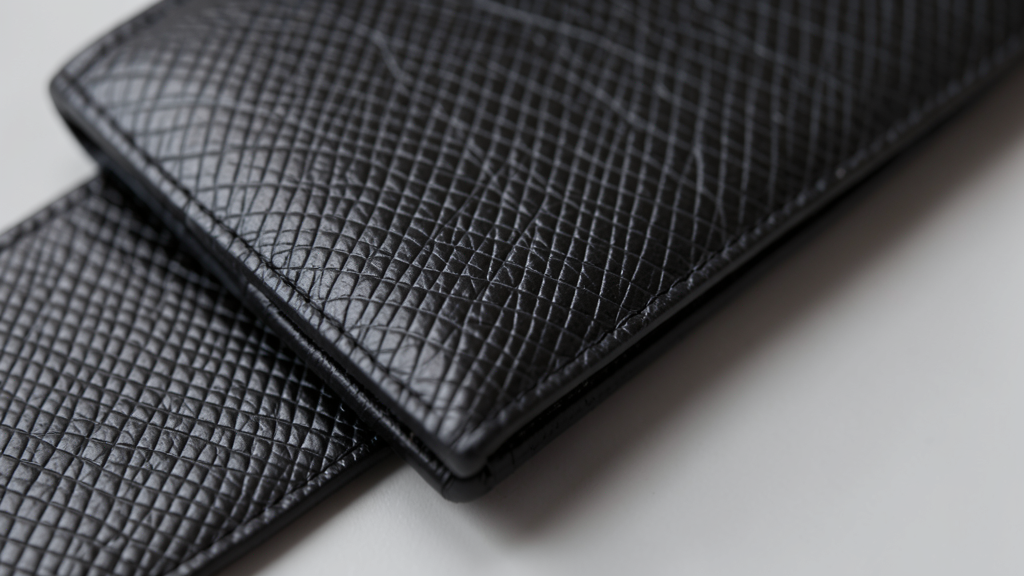
Saffiano leather is the cross hatched, tightly ruled surface you see on card holders and slim wallets, and it is not a tanning method at all. What is saffiano leather in practice: a cowhide pressed under a heated plate that stamps fine diagonal lines into the grain, then sealed with a coating. The stamping closes the surface, so keys and pocket grit slide over it instead of biting into it. Before picking a piece from our men’s leather bags aisle, it pays to know what that press really buys you, and what it takes away.
What the press does to the hide
The hide starts as full grain or corrected grain cowhide. A heated plate carrying the crosshatch motif comes down on it, crushing the top layer, closing the pores and locking the pattern in place. A resin finish then seals everything. Think of it as bodywork: the fibre stays underneath, the surface becomes a thin shell. That is the exact opposite of nubuck, which is sanded on the grain side to raise a short open nap that drinks in everything it touches. Nubuck records every drop; saffiano refuses marks for years, and ages far more quietly in exchange.
Spotting it by hand, in three moves
An embossed leather gives itself away to the eye and the fingertip. Look at the regularity first: on saffiano the diagonals repeat to the millimetre with no accidents, while a natural grained leather shows uneven relief and sometimes an old insect bite. Run a fingernail across it next: the surface feels hard, almost plasticised, and keeps no trace. Then fold the piece: saffiano breaks into short sharp creases, where a supple leather rolls in wide waves. None of these signs tells you the hide is good. They only tell you how it was finished.
Saffiano, natural grain, smooth full grain
All three sit side by side in shops and get confused constantly. The table below sorts them on what an owner actually notices after six months, rather than what shows in a display case. It extends the comparison we keep in the luxury men’s bags aisle, where the three finishes live together.
| Criterion | Embossed saffiano | Natural grain | Smooth full grain |
|---|---|---|---|
| Scratch resistance | very high | high | low |
| Behaviour with water | beads on the surface | absorbs slowly | marks fast |
| Suppleness | stiff | medium | supple |
| Patina over time | almost none | gradual | strong |
| Fixing a scuff | impossible without a trace | possible with cream | easy |
| Best suited to | wallets, card holders | everyday bags | evening pieces |
Caring for saffiano, and where it stops
Care comes down to two gestures. A soft cloth, barely damp, lifts the dust trapped in the hollows of the pattern, and a dry cotton cloth follows. Nourishing creams, essential on open leathers, do nothing here: the finish blocks them and they leave a greasy film. The real limit shows up the day the surface is cut. Because the colour sits on the resin rather than in the fibre, a deep scuff stays visible and no cream closes it. A saffiano men’s wallet therefore stays immaculate for years and then gets replaced, where an oiled leather gets repaired and handed down.
Where saffiano earns its place
The stiffness that hurts on a large bag turns into an advantage on small pieces: a card holder keeps its shape, a wallet does not warp, a belt does not twist in the loops. Here is a figure measured on our own catalogue on 22 September 2026, across 1,231 published product pages: 7 declare a grained leather and none declares saffiano, because suppliers who use it rarely write it into their specifications. In other words, judge the material on the close up photo and the description, never on the word alone.
- See the men’s wallets: short format, clean shape in a back pocket.
- See the men’s leather belts: an embossed surface takes fewer marks where the buckle rubs.
- See the men’s crossbody bags: the place to compare a stiff finish and a supple hide on one format.
Choosing saffiano means accepting a simple trade: a surface that stays flawless for a very long time, against a material that will never tell the story of your use. For a piece that lives in a pocket, that trade is excellent. For a bag you want to watch age, look instead at a grained leather or a full grain hide in the men’s leather bags aisle.
Saffiano and faux leather: the usual mix up
Because the surface is smooth, regular and coated, saffiano often gets taken for a synthetic, and the reverse happens just as much: plenty of faux leathers now copy the crosshatch, sometimes very well. Three checks settle it. The edge first: a hide shows tangled, slightly fuzzy fibres, a synthetic shows a clean cut over an even textile backing. The reverse side next: leather keeps an irregular flesh side, a synthetic shows the same woven cloth everywhere. Smell last, the most reliable test in a shop, animal and oily on one side, chemical on the other. The same markers help when you weigh leather against nubuck and the seller’s description stays vague.
In short
Saffiano is a finish, not a grade of hide: it protects very well, ages very little, and cannot be repaired. Take it for pieces that live in a pocket and must stay sharp, skip it for a bag you want to watch patinate. And always judge a hide by its edge and its reverse before judging its pattern, exactly as our notes on grained leather and the men’s leather bags aisle set out.
Frequently asked questions
Is saffiano leather real leather?
Yes, it is genuine animal hide, embossed and then coated. The doubt comes from the very uniform feel, which recalls a synthetic. A fake shows a regular textile backing and an edge with no visible fibre.
Does it really scratch less?
Light scratches, the kind keys or pocket grit leave, vanish into the relief of the pattern. A cut made with a sharp object stays perfectly visible and cannot be recovered.
Can I feed it with leather cream?
It is neither useful nor advisable. The finish blocks absorption, the cream sits on top and attracts dust. A damp cloth is enough, with heavily diluted saddle soap for a stubborn stain.
Why is it linked to Italian houses?
Italian luxury leather goods popularised the motif in the twentieth century, and the name stuck as a description of a finish, not as a brand. Any tannery can produce the embossing today, which is why quality varies widely behind an identical pattern.
