
Guides & Advice
Types of Leather: Layers, Finishes and Tanning Explained
Sep
The types of leather differ by the layer of hide used, the tanning and the finish. Those three choices, far more than the word leather on a label, decide how a bag holds up over the years. This guide ranks the leathers you meet in bags and small leather goods, from the toughest to the most delicate, with what each is really worth on a leather shoulder bag for men.
Types of leather by layer of hide
A thick hide is split into layers. The top layer, the grain, carries the natural surface and the tightest fibres: it is the strongest. Full grain leather keeps it intact, pores and marks included. Top grain, or corrected grain, is sanded and coated with a pigmented film to hide flaws. Split leather comes from the lower layer: less dense, it often becomes suede or gets a film that imitates grain.
| Type | Layer | Strength | How it ages |
|---|---|---|---|
| Full grain | Intact grain | Very high | Develops a patina |
| Top grain | Sanded grain | High | Stays uniform |
| Split leather | Lower layer | Medium | Can mark |
| Bonded leather | Glued fibres | Low | Flakes apart |
| PU leather | None, synthetic | Varies | Peels in time |
Leather types defined by their finish
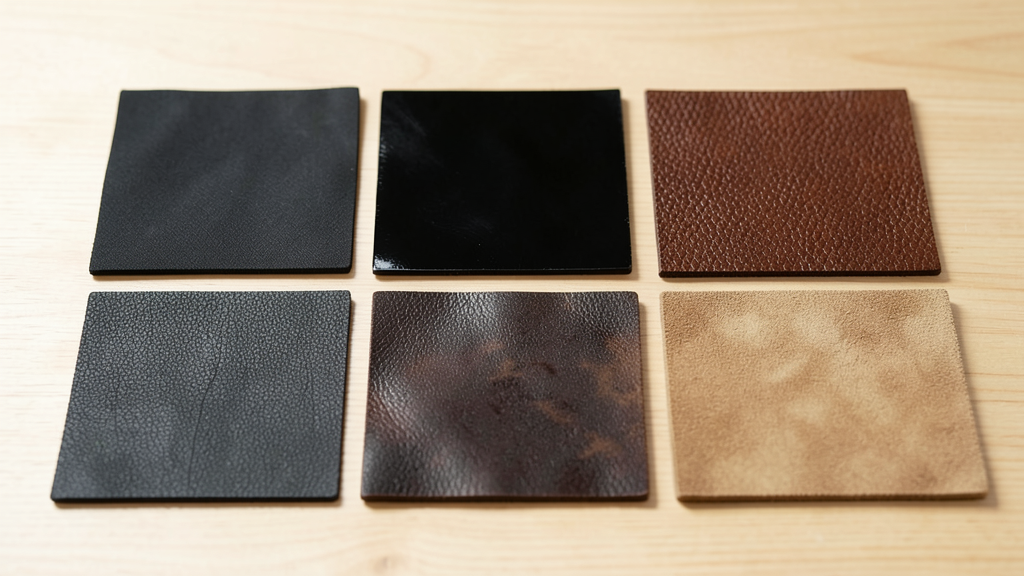
The same hide changes name with its surface treatment. Nappa leather is a very soft grain leather dyed through. Patent leather gets a glossy coating that makes it almost waterproof. Pebbled leather carries an embossed texture that hides scratches. Crazy Horse leather is oiled and waxed and lightens at every fold. Nubuck and suede are buffed for a velvet feel.
- Nappa: soft and supple, dislikes repeated rubbing.
- Patent: glossy and water resistant, cracks at folds.
- Pebbled: tough, hides everyday marks.
- Crazy Horse: fast patina, scratches fade when rubbed.
- Nubuck and suede: velvet touch, sensitive to water and grease.
Tanning, the part you cannot see
Chrome tanning is fast and cheap, and gives supple leather with bright colours that change little. Vegetable tanned leather spends weeks in bark tannins: firmer at first, it darkens and builds a patina with light and handling. Neither is better in absolute terms. Chrome suits bright colours and soft bags, vegetable tanning suits objects you keep for years.
Fake and reconstituted leathers
Two families often pass for leather. Bonded leather glues ground scraps together: it contains leather, but it flakes at the folds within a few years. PU leather is fully synthetic, a polyurethane film on a fabric backing, light and even, and it does not pretend to age like leather.
What our catalogue shows
Out of the 1,109 products in our shop, 397 mention leather. 86 are listed as genuine leather, 84 as PU leather, 38 as cowhide, 33 as full grain and 10 as Crazy Horse. None is nappa or patent leather: both finishes handle rubbing against a hip and the knocks of a daily bag poorly. To tell full grain from top grain, look at the edge, the smell and the pores, never the label alone.
Our leather selection
- Leather shoulder bags for men, from tablet size to laptop bags.
- Leather messenger bags, with flaps, for office and city.
- Mens leather wallets, in cowhide and Crazy Horse.
See all leather shoulder bags for men
Conclusion
For a bag carried every day, aim for full grain or a pebbled or oiled finish, which take the wear and improve with it. Keep nappa and patent for objects you treat gently, and take PU leather for what it is: light and affordable, not everlasting. Browse our leather shoulder bags for men and our guide on how to condition leather.
Frequently asked questions
What is the strongest type of leather?
Full grain leather, because it keeps the densest fibre layer of the hide. It resists wear and tearing better than any other layer.
Is genuine leather the best quality?
No. Genuine leather only guarantees that it is leather, not which layer. It often means corrected grain or split leather.
What is the difference between cowhide and full grain leather?
Cowhide names the animal, full grain names the layer. A leather can be both, or be split cowhide.
Is PU leather real leather?
No, it is a synthetic polyurethane material. It copies the look of leather without its fibrous structure.
