
Guides & Advice
What Is PU Leather? Definition, Care and What It Is Worth
Sep
PU leather is a composite material: a backing layer coated with polyurethane, then embossed to imitate the grain of an animal hide. It is neither real leather nor cheap plastic, and that middle position is exactly what makes the question hard to answer. This page covers what PU leather actually is, how it holds up, how to care for it, and the numbers from our own catalogue so you can decide on evidence instead of slogans. Our leather shoulder bags for men include both families, which is what makes a fair comparison possible.
What PU leather actually is
PU leather is made by bonding a polyurethane layer onto a backing. That backing changes everything, and it is the detail product pages leave out most often.
- Textile backing: coated cotton, polyester or microfiber. No animal hide is involved at any stage. This is by far the most common build.
- Split leather backing: the lower layer of a hide, left after splitting, receives the coating. Labels then say bonded leather or coated split leather depending on the country.
- High grade microfiber: a dense non woven sheet that mimics the fibre structure of a hide. It is the toughest version, and the most expensive.
Trade names blur the picture on purpose: faux leather, leatherette, vegan leather, synthetic leather and pleather all describe the same family. French law restricts the bare word leather to animal hide, so an item sold here as PU leather is playing straight. A men’s clutch bag that names its material openly tells you more than one that says nothing at all.
PU leather vs real leather, point by point
The difference can be seen, felt and measured. Here is what each material actually does, without the usual marketing lines.
| Criterion | PU leather | Full grain leather |
|---|---|---|
| Origin | polyurethane on a backing | top layer of the hide |
| Look when new | even, uniform grain | irregular, visible pores |
| Smell | neutral or chemical | distinctive, long lasting |
| Softness | immediate | earned through use |
| Patina | none, the surface stays put | darkens and records marks |
| Water | good surface resistance | marks easily when untreated |
| Repair | hard once the coating is breached | a craftsman can rework it |
| Average price on our shelves | 60.52 EUR | 118.51 EUR |
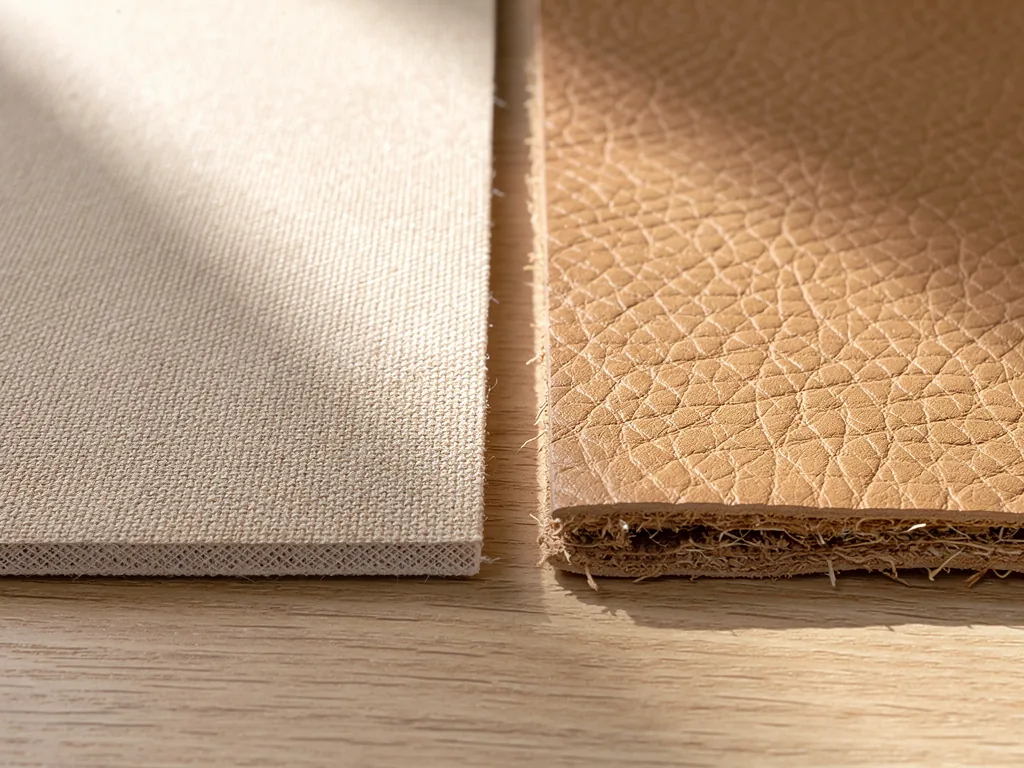
The quickest test takes three seconds: look at the cut edge. Real leather shows a fibrous, slightly fuzzy section. PU leather shows a clean cut, often with a line of a different colour, sometimes with the fabric visible. The second test is thermal: leather warms under your palm within seconds, PU stays cool much longer. Our black leather bags for men are a good place to practise, since black hides the grain but never the edge.
What 187 customer reviews say about PU leather
Most articles on this subject compare the two materials in theory. We sell both, and our buyers rate them. Here is the measurement, taken on 16 September 2026 across the full catalogue.
- 82 PU leather models, 187 customer reviews, average rating 4.70 out of 5, average price 60.52 EUR.
- 44 cowhide or full grain models, 151 reviews, average rating 4.92 out of 5, average price 118.51 EUR.
The satisfaction gap is real: 0.22 points out of five, and we are not going to hide it. But it costs nearly twice as much to close. Put differently, PU leather does not disappoint buyers, it satisfies them slightly less than a hide does, for half the money. That is the actual trade off, and it looks nothing like the usual verdict that treats PU as a failure. Our men’s bag sale is largely built on this material.
How to care for PU leather, and what never to do
Caring for PU leather is simpler than caring for a hide, on one condition: never use leather products on it. Conditioners, creams and waxes cannot soak into a polyurethane layer. They sit on the surface, turn tacky, and collect dust.
- Routine cleaning: a soft cloth, barely damp, then wipe dry straight away.
- Greasy mark: a drop of diluted neutral soap, dabbed on, never rubbed.
- Drying: open air, away from any radiator. Direct heat is the first enemy of the coating.
- Storage: stuffed with paper, flat or upright, never crushed under a pile. A crease sets permanently.
- Never use: alcohol, acetone, disinfectant wipes, shoe polish, grease, hair dryers.
The first area to fail is almost never the visible panel: it is the bottom corners and the strap anchor, where the material folds hundreds of times. On a men’s briefcase set down on the floor every day, check those four corners before anything else.
When PU leather is the right call, and when to buy a hide
The question is not which material wins in the abstract, but which one fits how you will actually use the bag. Three cases settle themselves.
- Daily city use on a controlled budget: PU leather holds up without asking for attention. It is the best ratio of money spent to service delivered.
- A bag meant to last years, with patina wanted: full grain earns its price, because it ages instead of wearing out.
- Wet or dirty environments: PU takes the lead again, its closed surface shrugging off splashes better than untreated leather.
One more criterion matters and is rarely mentioned: the hardware. A poor zip will fail long before any material does. Check the zips, the clips and the assembly stitching before you judge the surface. Our brown leather bags for men and our PU models are held to the same standard on that point.
Our picks to compare the two materials
The clearest way to decide is to compare at posted prices, across equivalent shapes.
- See the leather shoulder bags, both families side by side, from PU to full grain.
- See the bags on sale, where PU leather dominates and owns its positioning.
- See the premium models, to judge the finishing gap with your own eyes.
- See the briefcases, the category where a material shows its structure fastest.
In short
PU leather is an honest material as long as it is named honestly: even, easy to live with, unbothered by surface water, and half the price of a hide. It will not patina and it repairs badly, which points it towards a few years of service rather than a lifetime. Our 187 reviews put it at 4.70 out of 5 against 4.92 for real leather: the gap is measurable and it is not disqualifying. Choose on the lifespan you are aiming for, then check the hardware before the surface, comparing both families in our leather shoulder bag aisle.
Frequently asked questions
Does PU leather always peel?
No, and the blanket claim is wrong. The polyurethane layer degrades under heat, solvents and repeated folding in one spot. A bag stored flat, kept away from radiators and cleaned without alcohol keeps its surface intact far longer than the usual warnings suggest.
How can I spot PU leather in a shop?
Look at the cut edge of a flap or strap. A hide shows a fibrous, fuzzy section, PU shows a clean cut and sometimes a visible textile backing. Touch confirms it: leather warms quickly against your hand, PU stays cool.
Can damaged PU leather be repaired?
A light scuff can be touched up with a tinted repair kit. Once the backing shows through, no durable repair exists, because the coating cannot be re bonded. That is the material’s main limit against a hide, which a craftsman can rework.
Is vegan leather the same thing as PU leather?
In most cases, yes. Vegan leather is a commercial term that mainly covers polyurethane on a textile backing. A few genuine alternatives exist, made from cactus, apple or grape waste, but they remain rare and noticeably more expensive.
How long does a PU leather bag last?
We give no figure, because it depends on the backing, the thickness of the coating and above all on use. A bag carried daily and stored carelessly degrades within a few seasons; the same model looked after goes several years without visible damage.
