
Guides & Advice
How to Wear a Sling Bag: Position, Strap and Load
Jul
How to wear a sling bag comes down to three settings, and only three: which side of your body it sits on, how long the strap is, and how much you put in it. Get those right and the bag disappears into the outfit. Get them wrong and it reads as gear rather than clothing, which is the single complaint behind almost every photo people post asking what went wrong. A sling is not a small backpack and it is not a shoulder bag, so the habits you carry over from either one will fight it. This guide sets the three variables in order, says what belongs in the bag and what does not, and covers the questions that come up once you have worn one for a week. Our men’s sling bag range is the reference for the catalogue figures below.
- What a sling bag actually is
- Front, back or side
- Strap length, the setting that decides everything
- What to wear it with
- What belongs inside
- Slings worth looking at
- In short
What a sling bag actually is
A sling has one strap, fixed at both ends, worn diagonally across the torso so the body of the bag rests on the chest, the ribs or the lower back. The strap is structural: you cannot take it off, and the bag has no second attachment point. That single detail separates it from everything nearby. A backpack spreads weight over two shoulders and stays behind you. A shoulder bag hangs from one shoulder and swings. A crossbody sits lower, usually at the hip, on a thinner strap, and is closer to a small satchel in how it behaves. If the hip position is what you are after, our guide on how to wear a crossbody bag covers a different set of rules that do not transfer.
The consequence of one fixed strap is that the sling cannot be adjusted while worn the way a shoulder bag can be shrugged into place. It goes where the strap length puts it, and it stays there. That is why length is the setting that matters most, and why so much sling advice that starts with fabric and pockets is answering the wrong question first.
Front, back or side
There are three real positions, and they are not interchangeable. Each is right for a specific situation and visibly wrong outside it.
| Position | Bag sits | Best for | Cost |
|---|---|---|---|
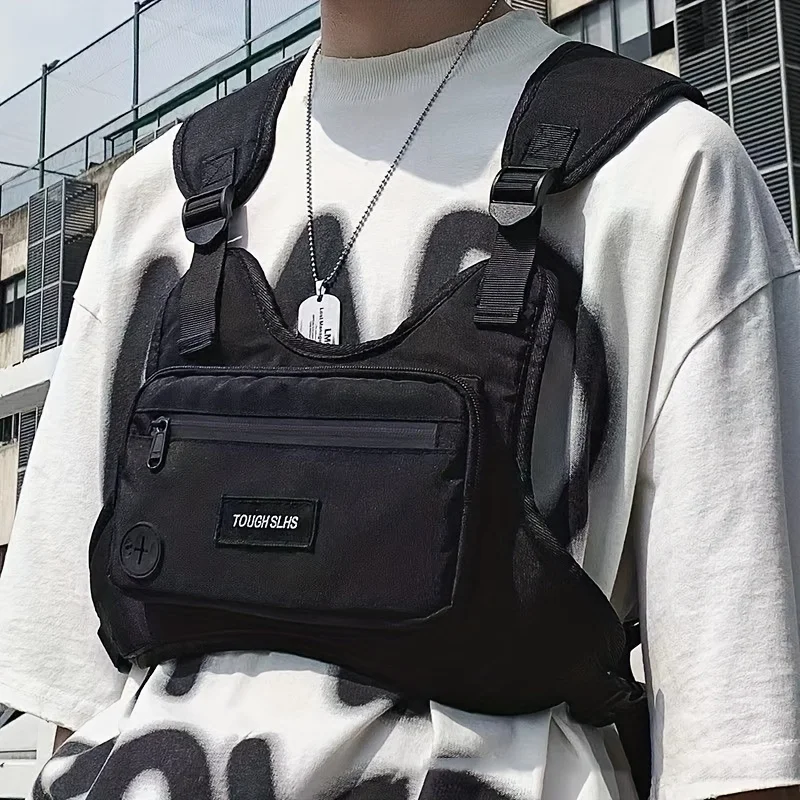
| Chest, front | On the sternum or just below | Crowds, transit, anything you need to reach without looking | Reads tactical if the bag is large |
| Front, low | Across the stomach, near the opposite hip | Walking a city, quick access, camera use | Gets in the way when seated |
| Back | Between shoulder blade and lower back | Cycling, running, anywhere hands stay free | You cannot reach it without swinging it round |
The swing is the feature that sells the format. A well fitted sling rotates from back to front in one motion, without taking the strap off, which is exactly what a backpack cannot do. If yours will not rotate smoothly, the strap is too short or the bag is too full, and you will find yourself taking it off instead, at which point you have bought a heavy pouch.
Side placement, with the bag parked over one hip, is the position people default to and the one that looks least deliberate. It happens when the strap is set too long. If you want a bag at hip height, buy a bag designed for hip height rather than stretching a sling into the job, and look at the small crossbody bags instead.
Strap length, the setting that decides everything
Here is the catalogue figure, counted on our own published range rather than estimated. Of 187 crossbody bags in stock, 117 state an adjustable strap. Of 162 chest bags, only 73 do, under half. That gap is worth knowing before you order, because a chest bag with a fixed strap is a garment sized to somebody else’s torso, and no amount of styling fixes it. Check the listing for an adjustment buckle the way you would check a shirt for a collar size.
Once you have adjustment, set it in this order.
- Start too short. Pull the strap until the bag sits high on the chest, then let it out. Working down from short finds the right point faster than working up from long, because a bag that is too low feels comfortable while looking wrong.
- Aim for the bag body to end at the bottom of the ribcage in the front position. Above that it crowds the chin. Below it and the bag starts riding on the stomach.
- Test the rotation. Swing it to the back and forward again. If the strap catches or the bag lifts your jacket, it is a couple of centimetres too short.
- Check it seated. Most slings are set standing and then worn on a train. If it digs in when you sit, let out enough that it rests on the thigh instead.
- Tuck or trim the tail. A loose strap end hanging past the buckle is the detail that makes an otherwise good bag look borrowed.
Strap width matters less than people expect but is not nothing. Anything under two centimetres cuts in once the bag is loaded and is better kept for very light carries. Padded straps are worth it above roughly two kilograms and unnecessary below. For heavier daily loads the format itself starts to fail, and a crossbody bag with a wider strap carries the same volume more comfortably.
What to wear it with
A sling crosses the torso, so it competes with whatever is already there: lapels, zips, prints, buttons. The rule that covers most cases is that the bag should contrast with the layer under it and agree with the shoes or the belt.
- Over a plain layer. Tee shirt, sweatshirt, knit, plain overshirt. The strap has a clean line to follow and the bag reads as intentional.
- Under an open jacket, not over it. Worn over a coat the strap pins the coat closed and bunches the shoulders. Under it, the bag stays reachable and the silhouette stays clean.
- Not over a suit jacket. A diagonal strap across structured tailoring crushes the chest and the lapel roll. If the day involves a jacket, carry a briefcase and leave the sling for the weekend.
- Match leather to leather. A leather sling with leather shoes and belt is the safest version of the look. Nylon and canvas slings sit better with trainers and are more forgiving of everything else.
- Scale to your frame. A large sling on a narrow torso reads as luggage. Small bags rarely look wrong on anyone, which is why the compact sizes are the safer first purchase.
What belongs inside
The format is defined by the fact that it sits against your body, so weight and shape are felt immediately rather than settling like they do in a backpack. Load it with that in mind.
- Phone, wallet, keys, earbuds, a card holder. This is the intended load and it is what the format does better than anything else.
- A compact water bottle, if the bag has an outside pocket. Inside, it turns the bag into a hard block against your ribs.
- A tablet up to about ten inches, in the bags that claim it. A thirteen inch laptop does not belong here even when it physically fits, and the laptop messenger bags exist for that reason.
- A camera body with one small lens. Slings are genuinely good camera bags because of the rotation, which is why so many photographers use them.
- Nothing rigid with corners. A power bank on edge or a hard glasses case will press into your side for the whole walk.
Two kilograms is the practical ceiling. Past that the single strap transfers load onto one trapezius and you will feel it within an hour. If your daily carry is heavier than that most days, the honest answer is that the sling is the wrong bag, not that you need a better one.
Slings worth looking at
- See the men’s sling bags, the core of the format, in the compact sizes that suit most frames.
- See the chest bags for the high front position, checking the listing for an adjustable strap first.
- See the leather crossbody bags if you want the look to dress up rather than down.
- See the belt bags, the smaller sibling, for days when a sling is more bag than you need.
In short
Wear a sling high and in front when you need access, on your back when you need your hands, and set the strap so the bag ends at the bottom of your ribs. Keep it under two kilograms, keep it under an open jacket rather than over it, and keep the strap tail tucked. Everything else is preference. Start with the sling bag range and check for strap adjustment before anything else, because it is the one thing you cannot fix afterwards.
Frequently asked questions
Should a sling bag be worn in front or behind?
In front when you need to reach it or you are in a crowd, behind when your hands are busy or you are moving fast. The point of the format is that you can change your mind without taking it off, so treat the position as a setting rather than a style choice.
Which shoulder should the strap go over?
Your non dominant shoulder, so the bag falls across to your dominant hand and you open it with the hand you write with. Swap sides occasionally anyway, because a single strap loads one side of the neck.
Is a sling bag suitable for work?
For a laptop free day, yes, worn under an open jacket. With tailoring or a laptop, no. The strap flattens a structured shoulder and the format tops out well below the weight of a working laptop kit.
Can a sling bag be worn over a coat?
It can, and it pulls the coat closed and bunches the collar. Under the coat is better in every respect except reach, and reach is what the rotation solves.
How big should a sling bag be?
Two to five litres covers phone, wallet, keys and a compact bottle, which is what most people actually carry. Above about eight litres the bag stops looking like an accessory and starts looking like equipment on anything but a large frame.
Are sling bags bad for your back?
Kept light they are fine, and the diagonal line spreads load better than a single shoulder strap. Loaded heavily they are worse than a backpack, because everything lands on one shoulder and the spine compensates by leaning.
