
Guides & Advice
Best weekender bag for men 2026: size, weight, cabin fit
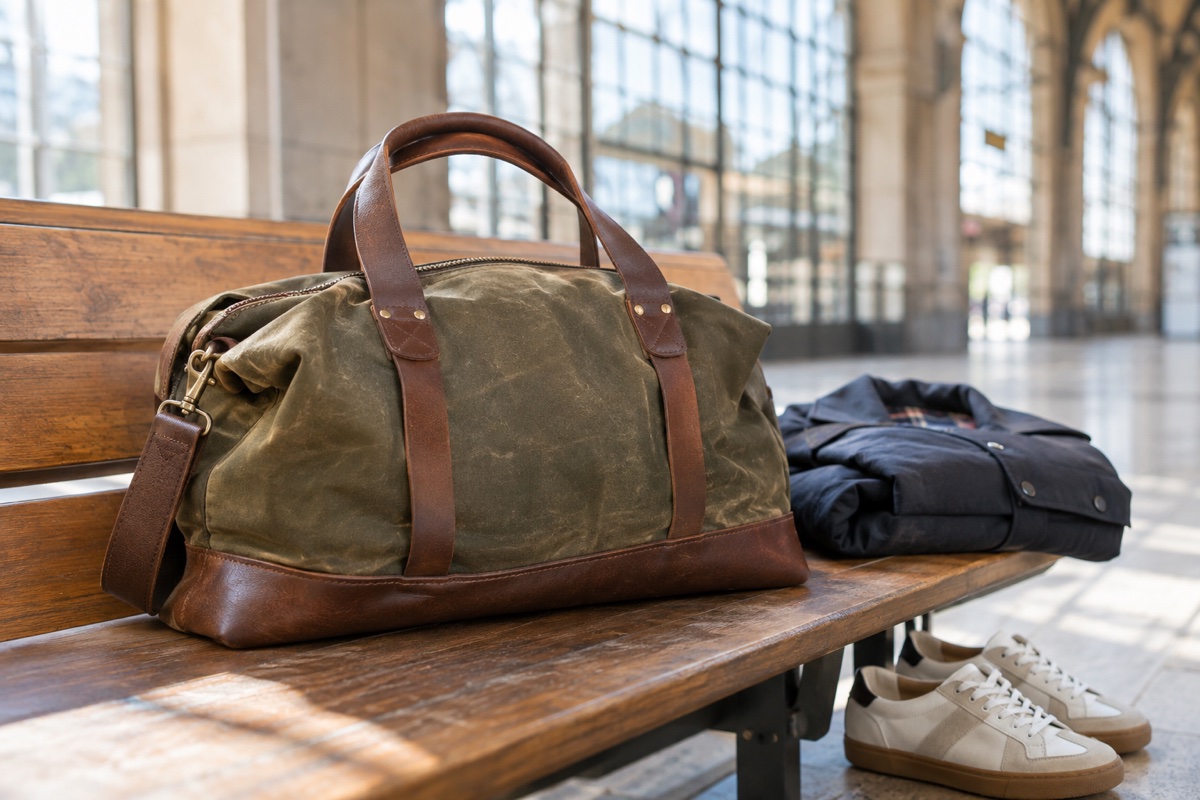
Nov
The best weekender bag for men is the one whose dimensions hold two or three days of clothes without being crammed, and that passes your airline’s cabin limit: 45 x 36 x 20 cm under the seat, 56 x 45 x 25 cm as a large cabin bag according to easyJet. This guide compares twelve formats from our weekender bag men range, measurement by measurement, with the calculated volume, the empty weight when the product page states it, and a cabin test you can repeat with a tape measure.
What is the best weekender bag for a man?
The best weekender bag for a man is the one whose volume follows the length of the trip: about 20 to 26 litres for one night, 30 to 42 litres for two or three days, and a format that stays under the cabin limit if you fly. The measurements decide before the material and the colour.
A single ranking would make no sense, because the same bag is perfect for one night and too small for a week. The twelve formats below are therefore judged on what their product page lets you check: dimensions, material, weight and stated storage. None is placed first, and no price is written here: the current price is on each product page.
The models in this guide come from two neighbouring ranges: the weekender bag men range, made for short stays, and the mens weekender bag range, which gathers travel bags of different sizes. For longer trips, the mens travel bag range shows more formats.
What do the weekender bags in our ranges measure?
Twelve formats from our ranges are compared below, ten models of which two come in two sizes. The outer volumes run from 20.7 to 49.5 litres. Every value comes from the product page, read on 2 November 2026; “not stated” means the page does not give the measurement. Dimensions are in centimetres.
| Model | Stated material | Dimensions in cm | Calculated outer volume | Stated weight | Stated storage |
|---|---|---|---|---|---|
| PU leather travel bag with shoe compartment | soft PU leather | 47 x 26 x 21 | 25.7 L | not stated | separate shoe compartment, handles and shoulder strap |
| Black barrel bag, small size | Oxford fabric, PU handles | 42 x 26 x 19 | 20.7 L | not stated | full-length zip |
| Black barrel bag, large size | Oxford fabric, PU handles | 47 x 28 x 20 | 26.3 L | not stated | full-length zip, shoulder strap |
| 46 cm travel bag | water-repellent technical fabric | 46 x 21.5 x 26 | 25.7 L | about 850 g | shoe compartment, six pockets, removable shoulder strap |
| Canvas duffel backpack, small size | thick cotton canvas | 45 x 26 x 20 | 23.4 L | 768 g (parcel weight) | zipped pocket, phone pocket, back pocket |
| Canvas duffel backpack, large size | thick cotton canvas | 55 x 30 x 20 | 33.0 L | 768 g (parcel weight) | zipped pocket, phone pocket, back pocket |
| Nylon weekender with shoe compartment | nylon | 51 x 25.5 x 23 | 29.9 L | not stated | shoe compartment, pocket for damp items |
| Roll-top weekender | waxed canvas, cowhide straps and base | 48 x 20 x 35 | 33.6 L | about 1.5 kg | rolled flap with buckled straps, zip |
| Vintage weekender with leather base | waxed canvas, cowhide base | 52 x 23 x 32 | 38.3 L | about 1.8 kg | two straps, zipped side pocket |
| Retro PU leather travel bag | soft PU leather | 55 x 30 x 25 (three measurements stated in no order) | 41.3 L | not stated | zipped front pocket, side pockets, shoulder strap |
| 55 cm weekender, waxed canvas and Crazy Horse leather | thick waxed canvas, genuine leather | 55 x 32 x 24 | 42.2 L | about 1.5 kg | zipped inner pocket, side pockets, shoulder strap |
| Waxed canvas duffle weekender | waxed canvas, cowhide handles and corners | 55 x 30 x 30 | 49.5 L | about 1.4 kg | large compartment, zipped pocket, removable shoulder strap |
The outer volume is the product of the three stated measurements, converted to litres: it is a ceiling, since the lining and the seams take space inside. It is still enough to compare the models with each other. The largest in the table, at 49.5 litres, holds 2.4 times the volume of the most compact, at 20.7 litres.
Two warnings about the data. The retro PU leather travel bag states “55, 30 and 25 cm” without saying which one is the length, width or height; we kept the usual order of a duffle, to be checked on the product page. And the weight of the canvas duffel backpack is the parcel weight, packaging included. To compare these models with other travel formats, the mens travel bag range gathers them all.
How many litres do you need for a weekend?
For a weekend of two or three days, a bag of 30 to 42 litres of outer volume is enough in our ranges: it takes a change of clothes, underwear, a wash bag and a pair of shoes. Below 26 litres the bag suits one night better; above 45 litres it invites you to pack too much.
The litre is a unit of volume equal to one cubic decimetre, that is 1,000 cubic centimetres, according to the Wikipedia page on the litre. A 52 x 23 x 32 cm bag therefore represents 38,272 cubic centimetres, or 38.3 litres: this simple calculation fills the volume column of the table. None of the ten product pages in the table states an inner volume in litres. Only the foldable weekender bag, a spare bag that folds flat, states volumes, three of them: 40, 90 and 180 litres.
The formats fall into three families. The five formats from 20 to 26 litres, between 42 x 26 x 19 cm and 47 x 28 x 20 cm, are one-night bags or spare bags. The three formats from 30 to 34 litres, from the 51 x 25.5 x 23 cm nylon bag to the 48 x 20 x 35 cm roll-top, are short-weekend formats. The four formats from 38 to 50 litres, from 52 x 23 x 32 cm to 55 x 30 x 30 cm, cover the extended weekend or a trip with extra shoes.
To go further on capacity, the travel bag for men range offers more formats sorted by size.
Which weekender bag fits in the cabin?
Two of the twelve formats fit under the seat under easyJet’s 45 x 36 x 20 cm limit: the black barrel bag in small size (42 x 26 x 19 cm) and the canvas duffel backpack in small size (45 x 26 x 20 cm). Eleven of twelve fit the large cabin bag of 56 x 45 x 25 cm, which is a paid option.
According to easyJet’s baggage help page, read on 2 November 2026, every passenger can bring one small cabin bag of up to 45 x 36 x 20 cm free of charge, including handles and wheels, which must fit under the seat and can weigh up to 15 kg. A large cabin bag of up to 56 x 45 x 25 cm, including handles and wheels, can be booked as an option. Limits vary from one airline to another: these ones are only a reference.
The test is to sort the bag’s three measurements from smallest to largest and compare them, in order, with the limit. The 52 x 23 x 32 cm bag becomes 23, 32 and 52: 23 is under 25, 32 under 45, 52 under 56, so it fits the large cabin bag. The 55 x 30 x 30 cm duffle becomes 30, 30 and 55: 30 is over 25, so it does not fit, even though its volume looks reasonable. The 46 x 21.5 x 26 cm bag fits the large format but not under the seat, because 46 is over 45 and 21.5 is over 20.
One important point: airlines measure with the handles, and our product pages do not always say whether their measurements include the handles. Add a few centimetres to be safe, or measure the bag when it is packed. The mens weekender bag range gathers smaller formats too.
Waxed canvas, nylon, Oxford or PU leather: which material should you choose?
The material of a weekender bag is chosen for its use: waxed canvas resists rain and develops a patina, nylon stays light and dries fast, Oxford fabric takes scuffs, and PU leather keeps an even surface that wipes clean with a cloth. None of these materials is better than the others.
In the table, four models are waxed canvas with cowhide trims, two are PU leather, two are Oxford or technical fabric, one is nylon and one is thick cotton canvas. The waxed canvas models carry cowhide finishes: handles, corners, straps or base, depending on the page. The pages specify that the canvas takes creases and highlights, and that the leather lightens where it rubs: this is a wanted patina, not a flaw.
PU leather, or polyurethane, is a synthetic material: its surface does not develop a patina and is not fed with creams. The two PU leather product pages in the table say so plainly, with a soft, aged look. On a bag put down in car boots, hotel halls and station floors, the even surface has a direct advantage: it cleans with a sponge and does not fear a greasy stain. The guide what is PU leather explains what the material is and what it is worth.
Nylon and Oxford fabric are technical textiles: neither leather nor imitation leather. They need no particular care. Nylon is treated as a non-waterproof textile, as the page of the large soft nylon travel bag in the range reminds: a bag left under heavy rain is protected like any ordinary textile. The waxed canvas bags range gathers the waxed canvas models.
How much does the bag weigh empty, and how much is left for your things?
A weekender bag from our ranges weighs from 850 g to 1.8 kg empty according to the five product pages that state the weight. easyJet’s limit for the small cabin bag is 15 kg: the heaviest bag in the table, at 1.8 kg, therefore leaves 13.2 kg of contents before that limit.
Relative to volume, weight does not follow size. The 49.5-litre waxed canvas duffle weighs about 1.4 kg, or 28 g per litre, while the 38.3-litre vintage bag with a leather base weighs about 1.8 kg, or 47 g per litre. In between, the 33.6-litre roll-top weighs about 1.5 kg (45 g per litre), the 42.2-litre Crazy Horse bag about 1.5 kg (36 g per litre) and the 25.7-litre 46 cm bag about 850 g (33 g per litre).
The product pages give a clue: the vintage model’s page explains that its whole base is cowhide leather, while the duffle limits the leather to the handles, the vertical bands and the corners. The pages do not give the share of each material, so the clue remains a hypothesis. What to remember is that weight per litre varies almost by a factor of two from one model to another.
Empty weight is not the main point: it is the total once packed that tires the arm and the shoulder. Weigh the packed bag at home, with a luggage scale or a bathroom scale. To compare with other formats, the gym bag men range gathers sports and gym bags.
Duffle, roll-top or barrel bag: which shape should you choose?
A zipped duffle suits someone who packs flat and wants full access; a roll-top follows the volume of the load; a canvas duffel backpack goes on the back and frees the hands. The right choice depends on how you move, not on the look.
The duffle is the simplest shape: one large compartment opened by a full-length zip, two handles, and a removable shoulder strap on most pages. Several models in the table use it, from the 20.7-litre Oxford barrel bag to the 49.5-litre waxed canvas duffle. The roll-top rolls on itself and closes with two straps: it gains height when full, rolls down further when there is spare room, and is carried by hand with a leather handle.
The canvas duffel backpack is a cylinder filled from the top, closed by a buckled flap, carried with two straps and a side handle. Its page states two sizes, 45 x 26 x 20 cm and 55 x 30 x 20 cm. The top opening gives access to the whole volume at once, but means emptying the bag to reach the bottom. The models with a separate shoe compartment, three in the table, keep soles away from the rest and suit people who go from sport to travel.
For those hesitating between a travel bag and a backpack for the weekend, the travel backpack for men range shows the models carried on both shoulders.
Weekender, gym bag or travel backpack: which should you choose?
A weekender with handles and a strap suits someone who goes from station to car boot, a gym bag someone who chains the gym and a commute, a travel backpack someone who walks for a long time with free hands. The formats overlap, but the main use decides.
In our table the border is thin: the nylon weekender and the 46 cm travel bag borrow the organisation of a gym bag, with a separate shoe compartment and pockets for damp items. What the weekender adds are longer dimensions and, on four models, cowhide finishes. The gym bag men range covers sporting use, and the travel backpack for men range offers the models carried on both shoulders.
The choice comes down to three questions. Where will the bag most often be put down: on a seat, in a boot, on a platform? How long will you carry it on foot: ten minutes from station to hotel, or an hour of walking? Do you need to keep shoes or damp items apart? A yes to the last question points to the three models with a separate compartment in the table; a long walk points to a duffel backpack with straps or a backpack.
Cabin format matters too, and the litre does not replace it: two bags of the same volume can behave very differently against the limit, as the 49.5-litre duffle, too thick, and the 33.6-litre roll-top, which fits, show. To compare a backpack seriously, apply the same rule as for the weekender: three measurements sorted from smallest to largest, compared with the limit.
How do you test a weekender bag before you leave?
A weekender bag is tested in five steps at home: lay out what you take, roll the clothes, fill the bag, weigh it, then carry it for ten minutes. The test takes a quarter of an hour and reveals the measurements the product page does not give.
First step, take out the weekend things and line them up: a change of clothes, underwear, a wash bag, a pair of shoes, a charger. Measure the longest object, add 2 cm, and compare with the largest dimension of the bag. Second step, roll the clothes rather than fold them: a rolled garment slips into a soft bag and leaves room for the shoes. Third step, fill the bag without forcing the zip: if it closes with difficulty, the format is too tight.
Fourth step, weigh the packed bag. For a flight, the weight limit is on the airline’s page; according to easyJet, the small cabin bag can weigh up to 15 kg, as long as you can lift and carry it yourself. Fifth step, carry the bag for ten minutes, by hand then on the shoulder, to feel whether the handles and the strap are comfortable. A bag that hurts the hand or slips off the shoulder is rarely fixed afterwards.
For cowhide leather bags, add a last check: look at the corners and the handles, which are the rubbing zones. According to the pages, the leather develops a patina there with travel, and the guide full-grain leather explains what full-grain leather is. When the parcel arrives, measure the empty bag and compare with the page: a difference of 1 to 3 cm is announced on two pages in the table, a larger difference should be reported through the contact page.
Which measurements are missing from the product pages before you buy?
Three pieces of information are most often missing from weekender bag pages: the empty weight, stated for five formats out of twelve, the inner volume in litres, stated for none of them, and the length of the shoulder strap, which no page gives in centimetres.
Three other pages in the range give only the parcel measurements, that is of the flat packaging, not of the packed bag: the large monogram-pattern weekender (parcel of 49 x 37 x 7 cm, 1.028 kg), the lightweight nylon travel bag (parcel of 29 x 19 x 10 cm, 446 g) and the large soft nylon travel bag (parcel of 41 x 33 x 5 cm, 757 g). We left them out of the table: a parcel measurement says nothing about capacity. The page of the first one states a coated material of polyurethane type, not leather. Two pages in the table also specify that their measurements are taken by hand, with a possible difference of 1 to 3 cm: the vintage bag with a leather base and the roll-top.
A last precision on words: “weekender”, “weekend bag” and “duffle” mean the same format here, a bag for two or three days, and the pages use “barrel bag” or “travel bag” interchangeably. Compare the measurements, not the names.
The method is the same for all models. Lay flat what you plan to take, measure the rolled set, add 2 cm, and compare with the largest dimension of the bag. For the cabin, measure the packed bag with its handles. A missing measurement is a point to check before buying, not one to guess: ask for it through the contact page. For formats that are not in this list, the travel bag for men range gathers more structured models.
Four product pages to start with
Four product pages in the shop cover the most common uses: a small bag that fits under the seat, a short-weekend bag with a shoe compartment, a roll-top for two or three days, and a waxed canvas duffle for the extended weekend. The measurements are those of the table; prices are on each product page.
- See the canvas duffel backpack: 45 x 26 x 20 cm in small size, easyJet’s small cabin bag limit, 23.4 litres.
- See the nylon weekender: 51 x 25.5 x 23 cm, 29.9 litres, a separate shoe compartment.
- See the roll-top weekender: 48 x 20 x 35 cm, about 1.5 kg, 33.6 litres, fits the large cabin bag.
- See the waxed canvas duffle: 55 x 30 x 30 cm, about 1.4 kg, 49.5 litres, the lightest per litre among the models whose weight is stated.
Conclusion: choosing a weekender bag with four measurements
The rule comes down to four measurements: the outer volume (from 20.7 to 49.5 litres in our ranges, 30 to 42 for a weekend of two or three days), the three dimensions compared with the airline’s cabin limit, the empty weight when the page gives it, and the material chosen for the use. All the models in this guide are gathered in the weekender bag men range, sold from 32,90 € à 253,90 €, and in the mens weekender bag range, sold from 21,90 € à 253,90 €.
Frequently asked questions
What is the best weekender bag for a man?
The best weekender bag for a man is the one whose volume follows the length of the trip, from 20 to 26 litres for one night and from 30 to 42 litres for two or three days in our ranges.
What size weekender bag for two or three days?
A weekender bag for two or three days measures between 48 x 20 x 35 cm and 55 x 32 x 24 cm in our ranges, which is 33 to 42 litres of calculated outer volume.
Does a weekender bag fit as cabin luggage?
A weekender bag fits as cabin luggage if it respects the airline’s limit, for example 45 x 36 x 20 cm under the seat or 56 x 45 x 25 cm as a large cabin bag according to easyJet.
Which material should you choose for a weekender bag?
The material of a weekender bag is chosen for its use: waxed canvas for the patina, nylon for lightness, Oxford fabric for scuffs, PU leather for an even surface that wipes clean.
Should you measure a weekender bag with its handles for the cabin?
Yes, you should measure the bag with its handles and strap folded away, because easyJet’s limit of 45 x 36 x 20 cm includes the handles, and our product pages do not always say whether their measurements include them.
Which weekender bag for a single night?
For a single night, the formats of 20 to 26 litres in our ranges are enough, such as the black barrel bag of 42 x 26 x 19 cm or the travel bag of 47 x 26 x 21 cm with a shoe compartment.
How much does a weekender bag weigh empty?
A weekender bag from our ranges weighs from 850 g to 1.8 kg empty according to the five product pages that state the weight, and the packed total is still to be weighed at home before leaving.
