


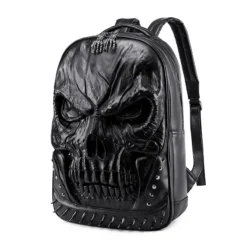
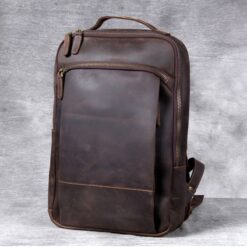
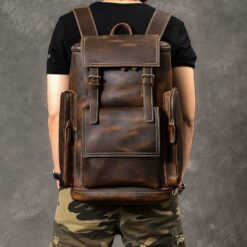


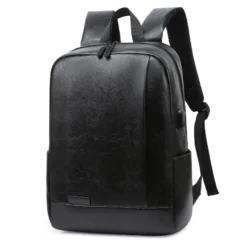
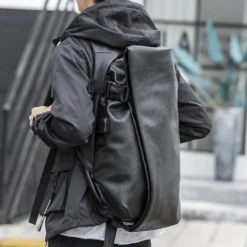


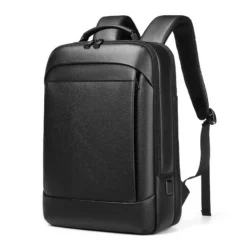

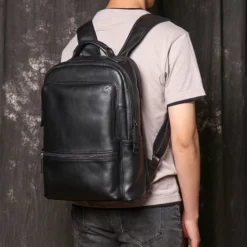
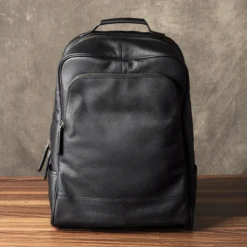


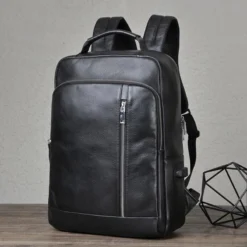
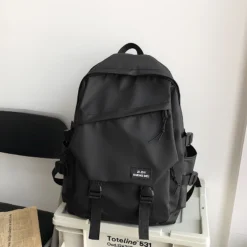
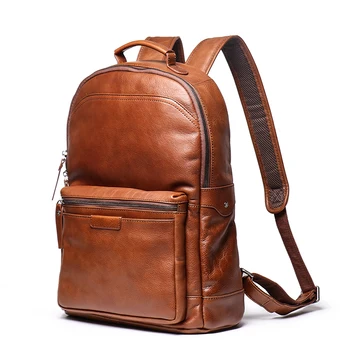

Also worth a look in this category:
The back panel matters more than the capacity
A flat back panel keeps the load against your spine. A rounded or padded one pushes it away, and every centimetre of distance multiplies the strain on your shoulders. Several models in this section are built with a deliberately flat back, and it is the single feature that separates a bag you wear from a bag you carry.
Check the strap anchor points too. Straps sewn wide apart sit badly on narrow shoulders and slide all day.
Grain, and what you are paying for
- Full grain keeps the hide surface. It scuffs, then the scuff becomes patina. It outlives the rest of the bag.
- Corrected grain is sanded and finished. Uniform, easier to live with, shorter character arc.
- Crazy horse is waxed full grain. Marks appear pale and rub back out with a finger.
- Coated or PU is not leather and we say so on the product page when that is the case.
None of these is a lesser choice in itself. Full grain rewards use, coated finishes reward neglect. Pick for how you treat your things.
My take
For a daily commute with a laptop, I would take a flat back and a lighter hide over a thicker one every time. For a bag that mostly travels and looks good doing it, full grain is worth the weight.
The mistake I see most often is buying capacity. A larger backpack does not carry more comfortably, it just lets you fill it.
Questions we get
How heavy is a leather backpack?
Considerably heavier than nylon, empty. Always add your laptop to the empty weight before deciding.
What laptop size fits?
Models here are specified around 14 and 15.6 inches. Match the padded sleeve, and measure the chassis rather than the screen.
Will it get wet?
Leather takes rain badly unless treated. If you cycle or walk in the wet daily, a coated finish or a cover is the practical answer.
Does it soften over time?
Full grain does, noticeably, over the first months. Corrected grain stays much as you bought it.